
- Also known as
- Delta sleep-inducing peptide · Delta-sleep-inducing peptide · Emideltide
- Class
- Neuropeptide (nonapeptide)
- Form
- Lyophilised powder (10 mg vial)
- Sizes
- 10 mg
- Storage, dry
- −20 °C, dry and dark
- Storage, mixed
- 2–8 °C, use within 28 days of mixing (as generally reported for reconstituted peptides)
- BAC water per size
- 10 mg: 2 mL
- Molecular weight
- About 849 g/mol (MW 849 as reported by Graf et al., 1984)
What is DSIP?
DSIP is a nonapeptide, Trp-Ala-Gly-Gly-Asp-Ala-Ser-Gly-Glu, isolated from rabbit cerebral venous blood in 1977 and named for its apparent link to delta (slow-wave) sleep. Early reviews describe mainly delta-sleep effects in rabbits, rats, mice and people, with a U-shaped dose-response curve. Its mechanism is still unclear: no DSIP gene, precursor protein or receptor has been isolated, and a 2006 review calls the case for DSIP as a sleep factor poorly documented. Human studies from the 1980s and 1990s gave it by intravenous infusion to people with chronic insomnia and to healthy volunteers, with mixed sleep results. Hormone studies found an ACTH drop in one trial and no effect on ACTH, cortisol, growth hormone or prolactin in others.
What the research shows
| Study | Model | Dose used | Duration | Finding |
|---|---|---|---|---|
| Bes F et al.1992 · Neuropsychobiology · PMID 1299794 | Human, double-blind randomised matched-pairs trial in chronic insomnia (n=16) | 25 nmol/kg intravenous DSIP or glucose placebo | Given the afternoon before nights 3, 4 and 5 of a 5-night laboratory stay | Sleep efficiency was higher and sleep latency shorter with DSIP, but the effects were weak and partly explained by a change in the placebo group. Subjective sleep quality did not change, and the authors concluded short-term DSIP is unlikely to be of major therapeutic benefit. |
| Monti JM et al.1987 · Int J Clin Pharmacol Res · PMID 3583493 | Human, double-blind crossover trial in chronic insomnia (n not stated in the abstract) | 25 nmol/kg intravenous or placebo | 4 nights | Total sleep time and NREM time rose, driven by stage 2 sleep, while slow-wave and REM sleep did not change. Differences from placebo already existed at baseline, and the authors judged the improvement of little clinical significance. |
| Schneider-Helmert D1987 · Eur Neurol · PMID 3622582 | Human, placebo-controlled double-blind trial in severe chronic insomnia (n=14) | Not stated in the abstract | 7 successive nights, plus a placebo night afterwards | Night sleep improved with the first dose and further with repeated doses, and the effect held on the first placebo night. Daytime alertness and performance increased significantly. |
| Schneider-Helmert D et al.1981 · Int J Clin Pharmacol Ther Toxicol · PMID 6895513 | Human, double-blind crossover in healthy volunteers (n=6) | 25 nmol/kg slow intravenous infusion, in the morning | Single infusion, sleep followed into the next night | Median total sleep time rose 59% within 130 minutes compared with placebo, without classic sedation on EEG and behavioural tests. The next night showed shorter sleep onset and better sleep efficiency, and no side effects were observed. |
| Pomfrett CJ et al.2009 · Eur J Anaesthesiol · PMID 19142086 | Human, randomised controlled trial in women under isoflurane anaesthesia (n=24; 12 DSIP, 12 saline) | Intravenous bolus of 25, 50 or 100 nmol/kg | Two doses: awake and after induction of anaesthesia | DSIP raised heart rate, lowered heart rate variability and, against the authors' hypothesis, reduced EEG delta rhythm and raised bispectral index at 25 nmol/kg, suggesting lighter anaesthesia. |
| Chiodera P et al.1994 · Horm Res · PMID 7698722 | Human, placebo-controlled trial in healthy men (n=8, plus 7 in a second arm) | 25 nmol/kg intravenous over 10 minutes | Single infusion before 2-hour saline or hypertonic saline, or an orthostatic test | DSIP significantly lowered ACTH but did not change basal vasopressin or the vasopressin rise after hypertonic saline or standing. |
| Späth-Schwalbe E et al.1995 · Psychoneuroendocrinology · PMID 7777652 | Human, placebo-controlled studies in healthy young men (n=5 per CRH condition; n=10 meal study) | Total 3 or 4 mg intravenous infusion | From 30 minutes before to 90 minutes after CRH injection; single session | ACTH and cortisol responses to CRH and to a midday meal were almost identical with DSIP and placebo. The authors say the data do not support an inhibitory role of DSIP on ACTH and cortisol in man. |
| Giusti M et al.1993 · Psychoneuroendocrinology · PMID 8475226 | Human, controlled study in healthy women (n=8) | 25 micrograms/kg intravenous over 30 minutes (or 1 hour in the circadian arm) | Single infusions | DSIP did not change basal growth hormone or prolactin, their circadian rhythm, or their response to arginine. |
What these studies don't show: Most of these studies are small, from the 1980s and 1990s, and all gave DSIP intravenously in a clinic; none used the subcutaneous or other routes discussed online. The insomnia results conflict, and the two most rigorous sleep trials found weak or clinically minor effects. DSIP has no identified receptor, and a 2006 review describes its role as a sleep factor as poorly documented. A mouse study of sleep used a DSIP fusion protein, not DSIP itself.
Every study links to its PubMed record. See all DSIP studies in the research library →
DSIP price in Australia: 10mg vial
Buy DSIP in Australia in a 10mg vial and a starter kit. Prices are in AUD, you pay by PayID or bank transfer, and orders are dispatched from Australian stock.
| Size | Price | Per mg | BAC water (example) |
|---|---|---|---|
| 10 mg | $95.99 | $9.60/mg | 2 mL |
The BAC water column is an example volume for the maths only. Open the calculator (pre-set for DSIP).
Starter kit
Is DSIP available in Australia?
DSIP is not registered on the ARTG; there is no TGA-approved product. It has no approved therapeutic use in Australia, including for sleep. Tasman supplies DSIP as a research chemical for laboratory use only, not for human use. How the TGA treats research peptides →
Side effects reported in studies
The early human DSIP studies reported it as well tolerated, with no psychological, physiological or biochemical side effects observed in six volunteers and no daytime sedation in six insomniacs. In an anaesthesia trial it raised heart rate and lowered heart rate variability.
Reconstitution
| Vial | BAC water (example) | Concentration |
|---|---|---|
| 10 mg | 2 mL | 5 mg/mL |
DSIP FAQ
Where can I buy DSIP in Australia?
Tasman Peptides supplies research-grade DSIP from Australian stock, for laboratory research only. It comes as lyophilised powder in 10 mg vials, and each batch is tested by HPLC. DSIP is not registered on the ARTG and is not sold for human use.
How much is DSIP per mg?
The cost per mg is shown in the size table on this page. DSIP is sold as a single 10 mg lyophilised vial, so the vial price divided by 10 gives the price per mg of peptide.
Is DSIP legal in Australia?
DSIP is not registered on the ARTG, and there is no TGA-approved DSIP product. It has no approved use in Australia, including as a sleep aid. Tasman supplies it as a research chemical for laboratory use only.
Does DSIP actually improve sleep?
The human evidence is mixed. A small 1981 volunteer study found 59% more sleep after an infusion, and a 7-night insomnia trial reported better sleep. Two later controlled insomnia trials found effects that were weak or of little clinical significance, and a 2006 review calls DSIP's role as a sleep factor poorly documented.
What is DSIP studied for?
DSIP is studied mainly for sleep regulation and for possible effects on stress hormones. Human trials tested it in chronic insomnia and healthy volunteers, and endocrine studies measured ACTH, cortisol, vasopressin, growth hormone and prolactin. One trial also tested it alongside isoflurane anaesthesia, where it lightened anaesthetic depth.
How does DSIP work?
Its mechanism is not known. No DSIP gene, precursor protein or receptor has been isolated, according to a 2006 review. Researchers have proposed that a related DSIP-like peptide may explain the immunoreactivity and activity seen in studies, but this has not been confirmed.
Does DSIP affect cortisol or growth hormone?
In the human studies here, DSIP did not change growth hormone or prolactin, and it did not alter ACTH and cortisol responses to CRH or a meal. One study of 8 men found a significant fall in ACTH after DSIP, so the evidence on ACTH is not consistent.
How should DSIP be stored?
Store the dry powder at −20 °C, sealed, dry and away from light. Once reconstituted, keep it at 2–8 °C and use it within 28 days, as is generally reported for reconstituted peptides. Avoid repeated freezing and thawing of the solution.
Is there a DSIP starter kit?
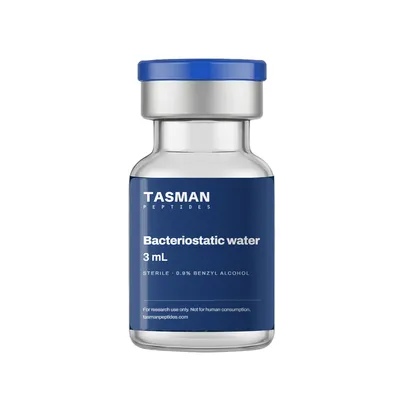
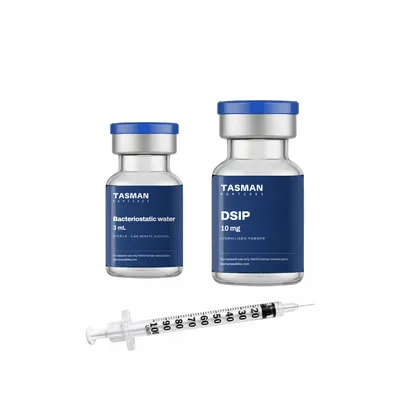
Yes. The DSIP starter kit pairs the 10 mg vial with the bacteriostatic water and basic supplies needed to reconstitute it in the lab. The kit contents are listed on the kit page, and the site calculator works out concentration from the volume of water used.
How much bacteriostatic water goes with a 10 mg vial?
As a neutral arithmetic default, 2 mL of bacteriostatic water in a 10 mg vial gives 5 mg per mL. The volume is a lab choice that sets the concentration, and the calculator on this page does the maths for any volume.