
- Also known as
- GLOW peptide · GLOW blend · GHK-Cu BPC-157 TB-500 blend · GLOW 70 mg · GLOW stack · GLOW peptide stack
- Class
- Three-peptide research blend (GHK-Cu 5 : BPC-157 1 : TB-500 1 by mass)
- Form
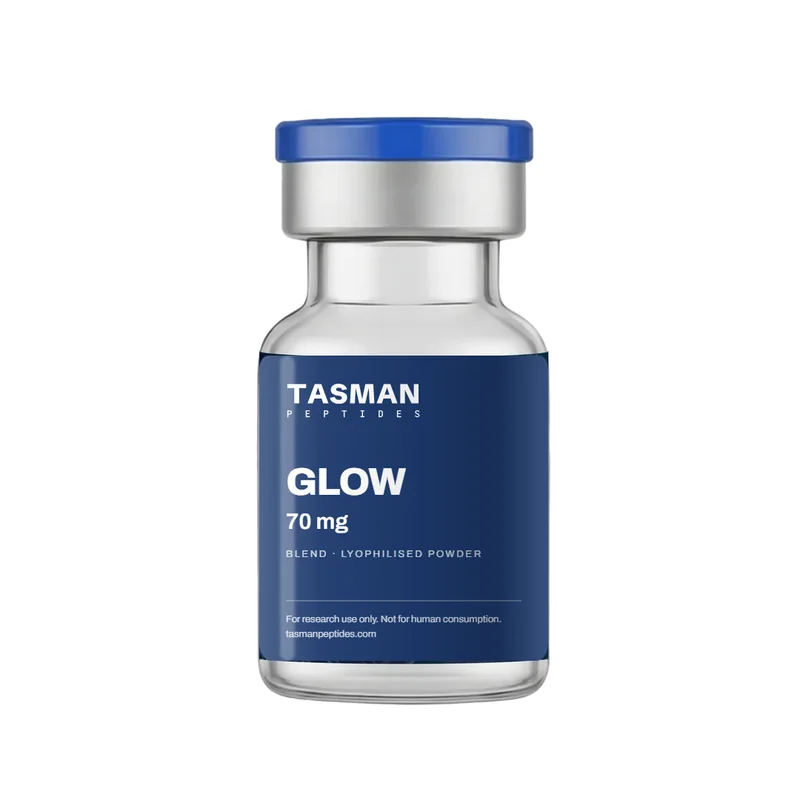
- Lyophilised powder, 70 mg vial (GHK-Cu 50 mg + BPC-157 10 mg + TB-500 10 mg)
- Sizes
- 70 mg
- Storage, dry
- −20 °C, dry and dark
- Storage, mixed
- 2–8 °C, use within 28 days of mixing (as generally reported for reconstituted peptides)
- BAC water per size
- 70 mg: 5 mL
What's in the vial
What is GLOW?
GLOW is a pre-mixed vial of three research peptides in a 5:1:1 ratio by mass. GHK-Cu, 50 mg, is the copper complex of the tripeptide Gly-His-Lys, which occurs naturally in human plasma and is studied mainly for skin, wound and fibroblast effects. BPC-157, 10 mg, is a 15-amino-acid peptide derived from a gastric protein and studied mostly in rat injury models. TB-500, 10 mg, is a supplier name for material related to thymosin beta-4, an actin-binding peptide studied mostly in mice. The name reflects the skin and tissue research behind the components, not a measured result. No published study has tested this blend or any combination of these three peptides. Each row below comes from a study of one component on its own.
What the research shows
| Study | Component | Model | Dose used | Duration | Finding |
|---|---|---|---|---|---|
| Miller TR et al.2006 · Arch Facial Plast Surg · PMID 16847171 | GHK-Cu | Human, randomised controlled trial (n=13 completed), skin after CO2 laser resurfacing | Topical skin care products with or without GHK-Cu; concentration not stated in the abstract | 12 weeks | Computer analysis and blinded evaluators found no significant difference between groups in erythema, wrinkles or overall skin quality. On the patient questionnaire, rated improvement in overall skin quality was higher in the GHK-Cu group (P = .04). |
| Pollard JD et al.2005 · Arch Facial Plast Surg · PMID 15655171 | GHK-Cu | Cell culture (normal and irradiated human dermal fibroblasts) | 1 × 10⁻⁹ mol/L | Not stated in the abstract | GHK-Cu shortened the population-doubling time of normal and irradiated fibroblasts. Treated irradiated fibroblasts produced significantly more basic FGF and VEGF than untreated controls early after exposure. |
| Wang X et al.2017 · Wound Repair Regen · PMID 28370978 | GHK-Cu | Mouse, scald burn model; human umbilical vein endothelial cells (HUVECs) | GHK-Cu in liposomes; amount not stated in the abstract | Wound healing time 14 days post injury in the liposome group | GHK-Cu liposomes raised HUVEC proliferation by 33.1% and gave better angiogenesis in burned skin than free GHK-Cu, with wound healing time shortened to 14 days. |
| Deng M et al.2023 · J Cachexia Sarcopenia Muscle · PMID 36905132 | GHK-Cu | Mouse (C57BL/6), cigarette-smoke muscle dysfunction model; C2C12 muscle cells; plasma GHK measured in people with COPD (n=9) and healthy controls (n=11) | 0.2 and 2 mg/kg (route not stated in the abstract) | Not stated in the abstract | GHK-Cu reduced smoke-induced loss of muscle mass and improved grip strength (175.5 g untreated vs 257.6 g and 339.1 g). Plasma GHK was lower in the COPD group than in controls. |
| Lee E et al.2024 · Altern Ther Health Med · PMID 39325560 | BPC-157 | Human, uncontrolled pilot study (n=12 women with interstitial cystitis), private clinic | 10 mg total, given by injection around the inflamed area of the bladder during cystoscopy | Single procedure; follow-up period not stated in the abstract | Ten of 12 patients reported complete resolution of symptoms and 2 of 12 rated their success at 80%. No adverse events were reported. The study had no control group. |
| Duzel A et al.2017 · World J Gastroenterol · PMID 29358856 | BPC-157 | Rat, ischaemic colitis and reperfusion model | 10 μg/kg as a bath (1 mL/rat) on the blood-deprived colon segment | 15 min vessel recording; day 10 in the colon obstruction group | BPC-157 increased vessel presentation and collateral connections, and MDA and NO levels were normal in treated rats. On day 10 the obstructed segments showed almost completely spared mucosa. |
| Maar K et al.2025 · Int J Mol Sci · PMID 40362372 | TB-500 | Mouse, permanent coronary ligation (heart attack) model; human cardiac cells | Systemic TB4 injection; amount not stated in the abstract | Not stated in the abstract | TB4 raised miR139-5p expression and modulated ROCK1 protein levels in mouse hearts and human cardiac cells, and may reverse or inhibit fibroblast-to-myofibroblast transformation. |
| Bako P et al.2023 · Int Immunopharmacol · PMID 38706788 | TB-500 | Mouse tympanic membrane (eardrum) explants, ex vivo and on collagen gels | Not stated in the abstract | Not stated in the abstract | TB4 affected the migration and proliferation of epidermal and epithelial cells of the tympanic membrane in vitro, most likely acting on local epidermal progenitor cells. |
What these studies don't show: No published study has tested GHK-Cu, BPC-157 and TB-500 together, in one vial or at a 5:1:1 ratio, so nothing here shows how the three interact or whether they stay stable when stored mixed. The only controlled human study of any component is a 13-patient trial of topical GHK-Cu skin products, and its objective measures found no difference between groups. The rest is small uncontrolled human work on BPC-157 and rodent or cell studies.
Every study links to its PubMed record. See all GLOW studies in the research library →
GLOW price in Australia: 70mg vial
Buy GLOW peptide stack in Australia in a 70mg vial and a starter kit. Prices are in AUD, you pay by PayID or bank transfer, and orders are dispatched from Australian stock.
| Size | Price | Per mg | BAC water (example) |
|---|---|---|---|
| 70 mg | $199.99 | $2.86/mg | 5 mL |
The BAC water column is an example volume for the maths only. Open the calculator (pre-set for GLOW).
Starter kit

Is GLOW available in Australia?
None of GLOW's three components, GHK-Cu, BPC-157 and TB-500, is registered on the ARTG as a medicine, and there is no TGA-approved product containing the blend. Combining them in one vial does not change the status of any component. Tasman supplies GLOW only as a research material for laboratory work, not for human use. How the TGA treats research peptides →
Side effects reported in studies
No study has measured side effects or results for the GLOW blend, because none has tested it. For the components, the one controlled human GHK-Cu trial found no objective difference from control skin products, the small BPC-157 pilots recorded no adverse events, and animal and tissue studies link high thymosin beta-4 to gut barrier disruption and cancer cell growth. Read more →
Doses used in studies
No study has used the GLOW blend, so there is no published GLOW dose. The component studies used GHK-Cu at 0.2 and 2 mg/kg in mice and 1 × 10⁻⁹ mol/L in cultured fibroblasts, BPC-157 at 10 mg in a single human bladder procedure and 10 μg/kg in rats, and thymosin beta-4 at amounts the abstracts do not state. These are the doses used in those studies only. Read more →
Reconstitution
| Vial | BAC water (example) | Concentration |
|---|---|---|
| 70 mg | 5 mL | 14 mg/mL |
GLOW FAQ
Where can I buy GLOW peptide in Australia?
Tasman supplies the GLOW blend from Australian stock for laboratory research only. It comes as a 70 mg vial of lyophilised powder holding GHK-Cu 50 mg, BPC-157 10 mg and TB-500 10 mg, tested by HPLC before dispatch. None of the three is registered on the ARTG as a medicine, and GLOW is not sold for human use.
What is the GLOW stack?
The GLOW stack is another name for the GLOW peptide blend: GHK-Cu 50 mg, BPC-157 10 mg and TB-500 10 mg pre-mixed in one 70 mg lyophilised vial. "Stack" is the name used in the research community for peptides studied together. Tasman supplies it as a single blend vial for laboratory research, and also as the GLOW builder stack, which pairs a GHK-Cu 50 mg vial with a Wolverine 10 mg blend vial. No published study has tested the combination itself; the evidence is for each component separately.
What is in the GLOW peptide blend?
GLOW holds three peptides in one 70 mg vial: GHK-Cu 50 mg, the copper complex of the tripeptide Gly-His-Lys; BPC-157 10 mg, a 15-amino-acid gastric peptide; and TB-500 10 mg, material related to thymosin beta-4. The ratio is 5:1:1 by mass, so GHK-Cu makes up about 71% of the powder.
Has the GLOW blend been studied?
No published study has tested GLOW or any combination of GHK-Cu, BPC-157 and TB-500. Every study on this page tested one component alone. The only controlled human study of any component is a 13-patient trial of topical GHK-Cu skin products, where objective measures found no difference from control products.
What is GLOW studied for?
The blend has not been studied. GHK-Cu is studied mainly for fibroblast growth, wound closure and skin, largely in cells and mice. BPC-157 is studied mostly in rat injury models, with three small human reports. Thymosin beta-4 is studied mostly in mice, in heart, liver, lung and eardrum models.
GLOW vs KLOW: what is the difference?
KLOW is GLOW with a fourth peptide added. GLOW is a 70 mg vial of GHK-Cu 50 mg, BPC-157 10 mg and TB-500 10 mg. KLOW is an 80 mg vial with the same three plus KPV 10 mg, a tripeptide studied mainly in rodent colitis models. Neither blend has been tested in a published study.
GLOW vs Wolverine: what is the difference?
Both contain BPC-157 and TB-500. The Wolverine blend is a 10 mg vial with 5 mg of each and nothing else. GLOW adds GHK-Cu 50 mg and carries 10 mg each of BPC-157 and TB-500, in a 70 mg vial. Neither combination has been tested in a published study.
How should GLOW be stored?
Dry GLOW powder is stored at −20 °C, sealed, dry and away from light. Once mixed, reconstituted peptides are generally reported to be kept at 2–8 °C and used within 28 days. No study in our records measured how the three peptides behave when stored mixed together, so the general figures are all that can be given.
Is GLOW legal in Australia?
None of GLOW's components, GHK-Cu, BPC-157 and TB-500, is registered on the ARTG as a medicine, and there is no TGA-approved product containing the blend. Putting them in one vial does not change the status of any component. Tasman supplies GLOW only as a research material for laboratory work.
How much is GLOW per mg?
The size table on this page shows the per-mg figure for the 70 mg vial. That figure covers all three peptides together. Because GHK-Cu makes up 50 of the 70 mg, the per-mg figure is not comparable with a single-peptide vial of BPC-157 or TB-500.
Is there a GLOW starter kit?
Yes. The GLOW starter kit pairs the 70 mg blend vial with the supplies used to reconstitute it for laboratory work, and the kit page lists exactly what is in the box. A GLOW builder stack, pairing a GHK-Cu 50 mg vial with a Wolverine 10 mg blend vial, is also listed under kits. Both are supplied for research use only.
Compare with
Related compounds
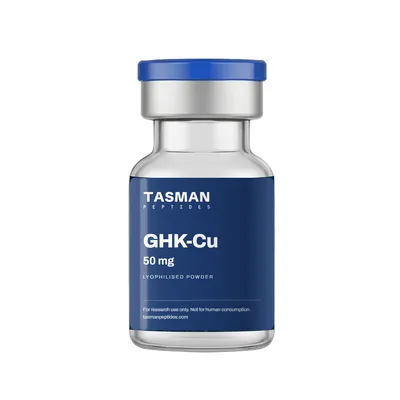
GHK-Cu
Copper-binding tripeptide (Gly-His-Lys copper complex)
KLOW
Four-peptide research blend (GHK-Cu, BPC-157, TB-500, KPV)
BPC-157
Synthetic pentadecapeptide derived from a gastric protein
TB-500
Thymosin beta-4 related peptide (actin-binding)