- Also known as
- GSH · reduced glutathione · L-glutathione · gamma-L-glutamyl-L-cysteinylglycine
- Class
- Endogenous tripeptide antioxidant
- Form
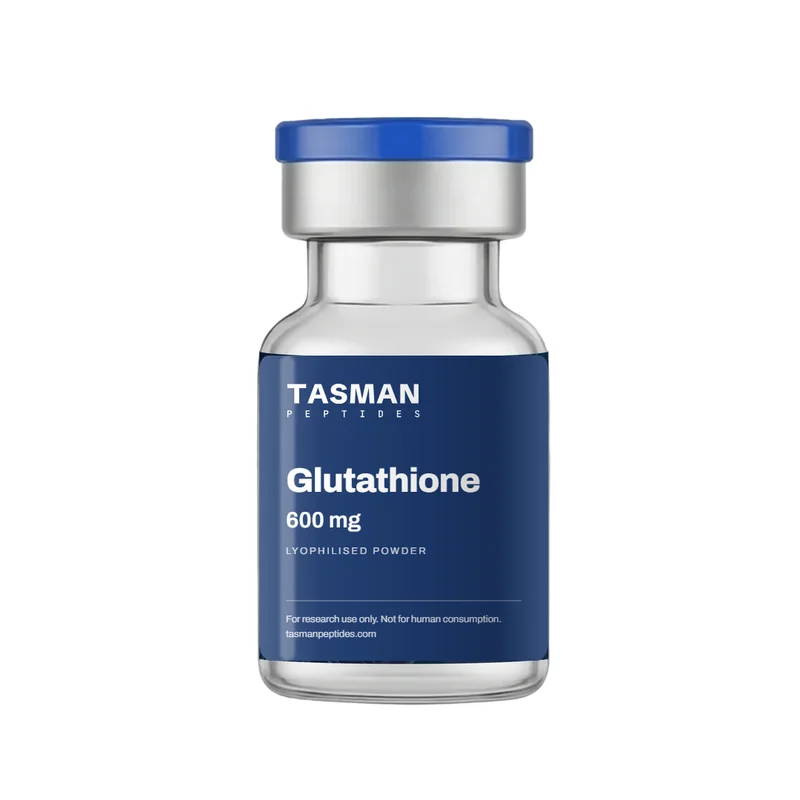
- Lyophilised powder, 600 mg in a 10 mL vial
- Sizes
- 600 mg
- Storage, dry
- −20 °C, dry and dark
- Storage, mixed
- 2–8 °C, use within 28 days of mixing (as generally reported for reconstituted peptides)
- BAC water per size
- 600 mg: 10 mL
- Molecular weight
- 307.3 g/mol
What is Glutathione?
Glutathione is a tripeptide of glutamate, cysteine and glycine that the body makes in nearly every cell. The free sulfhydryl group on its cysteine lets it neutralise oxidants such as hydrogen peroxide, and in doing so it is converted from the reduced form (GSH) to the oxidised form (GSSG). The GSH/GSSG ratio is therefore a common lab marker of oxidative stress. Cysteine supply limits how fast cells can make it. Human trials of glutathione given directly fall into two groups: intravenous infusions, studied in oxaliplatin chemotherapy and heart-attack reperfusion, and oral supplements, studied for blood glutathione levels, insulin sensitivity, skin pigmentation, acne and growth in cystic fibrosis. Other trials raise glutathione indirectly by supplying precursors such as N-acetylcysteine or whey protein.
What the research shows
| Study | Model | Dose used | Duration | Finding |
|---|---|---|---|---|
| Cascinu S et al.2002 · J Clin Oncol · PMID 12177109 | Human, randomised double-blind placebo-controlled trial (n=52), advanced colorectal cancer on oxaliplatin | 1,500 mg/m² by intravenous infusion over 15 minutes before each oxaliplatin dose | Bimonthly oxaliplatin regimen, assessed after 4, 8 and 12 cycles | Grade 2–4 neuropathy occurred in 2 patients on GSH vs 11 on placebo (P = .003), and after 12 cycles in 3 vs 8 (P = .004). Tumour response was 26.9% vs 23.1%, so GSH did not reduce oxaliplatin activity. |
| Tanzilli G et al.2019 · BMJ Open · PMID 31399448 | Human, randomised controlled pilot trial (n=50), STEMI patients undergoing primary angioplasty | 2,500 mg in 25 mL by intravenous infusion over 10 minutes before the procedure, repeated at 24, 48 and 72 hours | 4 infusions over 72 hours; blood sampled up to 5 days | After reperfusion the GSH group had lower H2O2 production and 8-iso-PGF2α and higher H2O2 breakdown activity and nitric oxide bioavailability than placebo. Lower H2O2 production persisted to day 5 and tracked troponin T levels. |
| Richie JP et al.2015 · Eur J Nutr · PMID 24791752 | Human, randomised double-blind placebo-controlled trial (n=54 healthy non-smoking adults) | 250 or 1,000 mg/day, oral | 6 months, then a 1-month washout | At 6 months the high dose raised GSH by 30–35% in erythrocytes, plasma and lymphocytes and by 260% in buccal cells; the low dose raised blood and erythrocyte GSH by 17% and 29%. Levels returned to baseline after washout, and natural killer cytotoxicity more than doubled at 3 months on the high dose. |
| Søndergård SD et al.2021 · Appl Physiol Nutr Metab · PMID 33740389 | Human, randomised double-blind placebo-controlled trial (n=20 obese males, 10 with type 2 diabetes) | 1,000 mg/day, oral | 3 weeks | Whole-body insulin sensitivity by hyperinsulinaemic-euglycaemic clamp increased significantly with GSH. Muscle GSH rose about 19% (numerically only), and mitochondrial H2O2 emission and urinary oxidation markers did not change. |
| Bozic M et al.2020 · J Pediatr Gastroenterol Nutr · PMID 32960827 | Human, multicentre randomised double-blind placebo-controlled phase II trial (n=58 completed), children aged 2–10 with cystic fibrosis | Not stated in the abstract (reduced glutathione, oral, daily) | 24 weeks | No significant difference from placebo in weight-for-age z-score, weight, BMI or serum and faecal inflammatory markers. Glutathione was reported as safe and well tolerated. |
| Mawu FO et al.2025 · Acta Dermatovenerol Alp Pannonica Adriat · PMID 41014073 | Human, randomised controlled trial (n=40), mild to moderate acne vulgaris | 500 mg once daily, oral | 4 weeks | Serum nitric oxide and IL-1α fell in the glutathione group but not significantly (p > 0.05). Seven of 22 subjects (31.8%) improved from moderate to mild severity, and no adverse reactions were reported. |
| Duperray J et al.2022 · J Cosmet Dermatol · PMID 33834608 | Human, randomised double-blind placebo- and benchmark-controlled trial (n=124 Asian women) | Oral, daily: 500 mg L-cystine + 250 mg L-glutathione, 250 mg L-glutathione alone, 500 mg L-cystine alone, or placebo | 12 weeks | The cystine plus glutathione combination significantly lightened skin by spectrophotometry and reduced facial dark-spot size at 6 and 12 weeks. Its effect was significantly better than placebo and than either ingredient alone. |
What these studies don't show: Only two of these trials used intravenous glutathione, both in hospital settings with fewer than 55 patients, and both measured short-term markers rather than long-term outcomes. The oral trials were small, ran from 3 weeks to 6 months, and gave mixed results: the cystic fibrosis and acne trials found no significant effect on their main measures. None of the records compares routes directly, and none tests a 600 mg vial preparation.
Every study links to its PubMed record. See all Glutathione studies in the research library →
Glutathione price in Australia: 600mg vial
Buy Glutathione in Australia in a 600mg vial and a starter kit. Prices are in AUD, you pay by PayID or bank transfer, and orders are dispatched from Australian stock.
| Size | Price | Per mg | BAC water (example) |
|---|---|---|---|
| 600 mg | $79.99 | $0.13/mg | 10 mL |
The BAC water column is an example volume for the maths only. Open the calculator (pre-set for Glutathione).
Starter kit
Is Glutathione available in Australia?
Glutathione in this research form is not registered on the ARTG, and there is no TGA-approved product. Tasman Peptides supplies the 600 mg vial as a research chemical for laboratory use only. It is not sold as a medicine, supplement or cosmetic. How the TGA treats research peptides →
Side effects reported in studies
Three of the oral trials reported glutathione as well tolerated or as causing no adverse reactions, but no abstract gives adverse-event rates. The measured results were higher glutathione levels in blood and cells with oral dosing, less oxaliplatin neuropathy and lower oxidant markers with intravenous dosing, and no effect on growth in children with cystic fibrosis.
Reconstitution
| Vial | BAC water (example) | Concentration |
|---|---|---|
| 600 mg | 10 mL | 60 mg/mL |
Glutathione FAQ
Where can I buy glutathione in Australia?
Tasman Peptides supplies research-grade glutathione as a 600 mg lyophilised powder in a 10 mL vial, dispatched from Australian stock. It is sold for laboratory research only, not as a medicine, supplement or cosmetic, and not for human use. It is tested by HPLC, and the purity result is shown on the product page.
How much is glutathione per mg?
The cost per mg is shown in the size table on this page. Glutathione is sold in one size, a 600 mg vial, and the table lists the vial and the starter kit so the per-mg figure can be read off directly.
What is glutathione studied for?
Glutathione is studied mainly as an antioxidant and a marker of oxidative stress. Human trials have tested intravenous glutathione alongside oxaliplatin chemotherapy and in heart-attack reperfusion, and oral glutathione for blood and cell glutathione levels, insulin sensitivity, skin pigmentation, acne and growth in children with cystic fibrosis. Results varied by trial.
Which route did the glutathione studies use, IV or oral?
Both routes appear in the trials on this page. The oxaliplatin and angioplasty trials used intravenous infusions of 1,500 mg/m² and 2,500 mg. The healthy-adult, insulin-sensitivity, acne, skin and cystic fibrosis trials all gave it by mouth, at 250–1,000 mg a day where the abstract states the dose. Results from one route do not transfer to another.
Does oral glutathione raise glutathione levels?
In one six-month randomised trial it did. Healthy adults taking 1,000 mg a day by mouth had 30–35% higher glutathione in erythrocytes, plasma and lymphocytes, and 250 mg a day raised blood and erythrocyte levels by 17% and 29%. Levels fell back to baseline within a month of stopping.
Is glutathione legal in Australia?
The research-grade glutathione sold here is not registered on the ARTG, and there is no TGA-approved product. Tasman supplies it only as a research chemical for laboratory work. It is not sold for therapeutic, cosmetic or dietary use.
How should glutathione be stored?
Keep the dry powder at −20 °C, sealed and away from light. Once reconstituted, store it at 2–8 °C and use it within about 28 days, the figure generally reported for reconstituted peptides. Reduced glutathione oxidises to GSSG when exposed to air, so keep the vial closed.
How much bacteriostatic water for a 600 mg glutathione vial?
The 600 mg vial is a 10 mL vial, and the starter kit pairs it with 10 mL of bacteriostatic water. Filled to 10 mL, the concentration works out at 60 mg per mL. The site calculator converts any other volume into mg per mL; this is arithmetic only.
What comes in the glutathione starter kit?
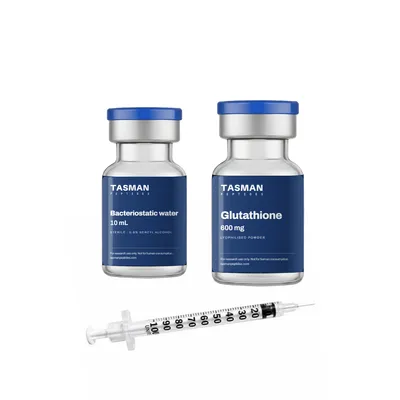
The glutathione starter kit contains one 600 mg vial, 10 mL of bacteriostatic water, ten 1 mL insulin syringes and 20 alcohol swabs. It groups the reconstitution supplies for bench work in one order. The vial is the same product sold on its own.
Glutathione vs NAD+: what is the difference?
Glutathione is a tripeptide antioxidant, while NAD+ is a coenzyme that carries electrons in energy metabolism. Glutathione studies usually measure oxidative stress markers such as the GSH/GSSG ratio or H2O2. NAD+ studies look at metabolic and cellular energy measures. The comparison page sets out the evidence for each.