
- Also known as
- Reta + Cagri · Retatrutide Cagrilintide blend · Reta Cagri · LY3437943 + cagrilintide
- Class
- Two-peptide research blend
- Form
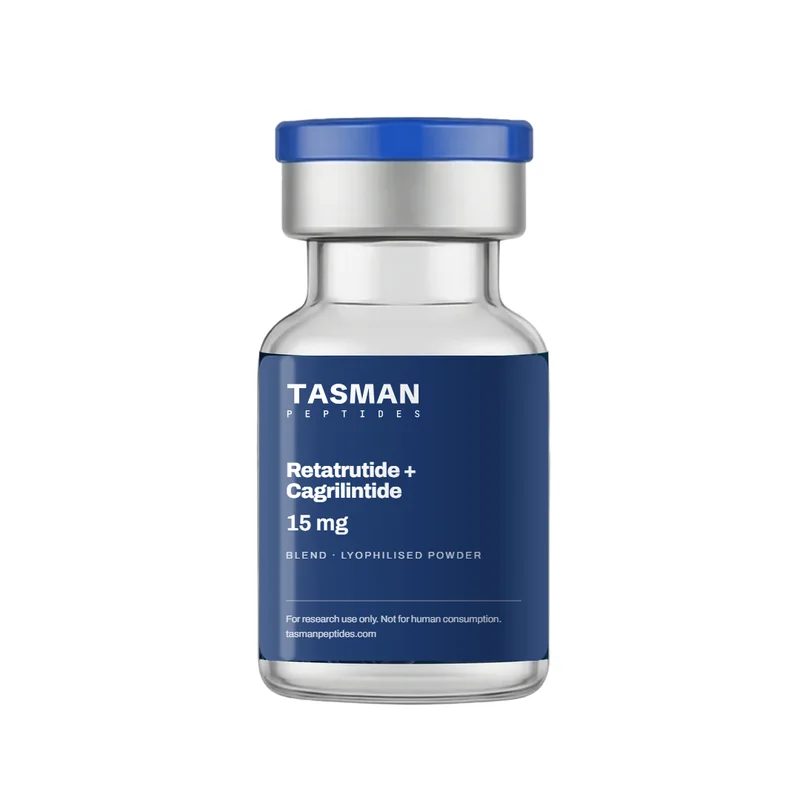
- Lyophilised powder, one vial, combined 15 mg
- Sizes
- 15 mg
- Storage, dry
- −20 °C, dry and dark
- Storage, mixed
- 2–8 °C, use within 28 days of mixing (as generally reported for reconstituted peptides)
- BAC water per size
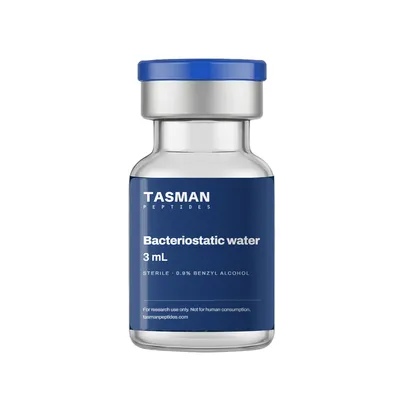
- 15 mg: 3 mL
What is Retatrutide + Cagrilintide?
Retatrutide + Cagrilintide is a research blend of two peptides in one vial, a combined 15 mg. Retatrutide (LY3437943) is a single peptide that activates three hormone receptors: GIP, GLP-1 and glucagon. Cagrilintide is a long-acting analogue of amylin, a pancreatic hormone that induces satiety, and it acts at the amylin receptor. The two act on different receptor systems. Each has been studied in human trials as a once-weekly subcutaneous injection, measuring body weight, HbA1c and related markers. No published study has tested retatrutide and cagrilintide together. The combination trials of cagrilintide paired it with semaglutide, a GLP-1 receptor agonist, as CagriSema, not with retatrutide. The studies below are single-compound work, grouped by component. Tasman supplies this blend as a lyophilised powder for laboratory research.
What the research shows
| Study | Model | Dose used | Duration | Finding |
|---|---|---|---|---|
| Jastreboff AM et al.2023 · N Engl J Med · PMID 37366315 | Human, phase 2 randomised controlled trial in adults with obesity (n=338) | 1, 4, 8 or 12 mg once weekly, subcutaneous (4 and 8 mg arms started at 2 or 4 mg; 12 mg started at 2 mg), vs placebo | 48 weeks | Mean body weight change at 48 weeks was −8.7% (1 mg), −17.1% (4 mg), −22.8% (8 mg) and −24.2% (12 mg) vs −2.1% with placebo. The most common adverse events were gastrointestinal, dose-related and mostly mild to moderate. |
| Bajaj HS et al.2026 · Lancet · PMID 42250575 | Human, phase 3 randomised controlled trial in adults with type 2 diabetes (n=537) | 4, 9 or 12 mg once weekly, subcutaneous, vs placebo | 40 weeks | HbA1c fell by 1.69%, 1.86% and 1.94% with 4, 9 and 12 mg vs 0.81% with placebo, and body weight changed by −11.5%, −13.9% and −15.3% vs −2.6%. Discontinuation for adverse events was 2–5% with retatrutide and 0% with placebo. |
| Sanyal AJ et al.2024 · Nat Med · PMID 38858523 | Human, phase 2a randomised controlled substudy in adults with MASLD and ≥10% liver fat (n=98) | 1, 4, 8 or 12 mg once weekly, subcutaneous, vs placebo | 48 weeks (liver fat primary endpoint at 24 weeks) | Mean relative change in liver fat at 24 weeks was −42.9% (1 mg), −57.0% (4 mg), −81.4% (8 mg) and −82.4% (12 mg) vs +0.3% with placebo. |
| Urva S et al.2022 · Lancet · PMID 36354040 | Human, phase 1b randomised multiple-ascending dose trial in type 2 diabetes (n=72) | 0.5, 1.5, 3, 3/6 or 3/6/9/12 mg once weekly, subcutaneous, vs placebo or dulaglutide 1.5 mg | 12 weeks | Treatment-emergent adverse events were reported by 63% of participants on LY3437943, 60% on dulaglutide and 54% on placebo, with gastrointestinal disorders the most frequent. |
| Lau DCW et al.2021 · Lancet · PMID 34798060 | Human, phase 2 randomised controlled trial, cagrilintide alone, adults with overweight or obesity without diabetes (n=906 randomised: 706 cagrilintide, 99 liraglutide, 101 placebo) | Cagrilintide 0.3, 0.6, 1.2, 2.4 or 4.5 mg once weekly, subcutaneous; comparator liraglutide 3.0 mg once daily | 26 weeks treatment (including up to 6 weeks escalation), plus 6 weeks follow-up | Mean weight reduction was 6.0%–10.8% across the cagrilintide doses versus 3.0% with placebo. Cagrilintide 4.5 mg reduced weight by 10.8% compared with 9.0% for liraglutide 3.0 mg. |
| Gabe MBN et al.2024 · Diabetes Obes Metab · PMID 39279639 | Human, randomised double-blind thorough QT study, cagrilintide alone, healthy participants (n=105) | Cagrilintide once weekly subcutaneous, escalated to 4.5 mg; placebo arms received moxifloxacin 400 mg as a positive control | Not stated in the abstract | No clinically relevant QTcF prolongation occurred after the last 4.5 mg dose; the upper limits of the 90% confidence intervals of the placebo-adjusted changes were below 10 ms at all time points. |
| Frias JP et al.2023 · Lancet · PMID 37364590 | Human, phase 2 randomised double-blind trial, CagriSema (cagrilintide + semaglutide) vs semaglutide vs cagrilintide, type 2 diabetes on metformin (n=92) | CagriSema, semaglutide or cagrilintide, each escalated to 2.4 mg once weekly subcutaneous | 32 weeks | HbA1c fell by 2.2 points with CagriSema, 1.8 with semaglutide and 0.9 with cagrilintide alone. Body weight fell by 15.6%, 5.1% and 8.1% respectively. The partner drug in this trial was semaglutide, not retatrutide. |
| Garvey WT et al.2025 · N Engl J Med · PMID 40544433 | Human, phase 3a randomised controlled trial (REDEFINE 1), CagriSema vs each component vs placebo, adults with overweight or obesity without diabetes (n=3417) | Cagrilintide 2.4 mg + semaglutide 2.4 mg, semaglutide 2.4 mg, cagrilintide 2.4 mg, or placebo, once weekly | 68 weeks | Mean body weight change was −20.4% with CagriSema (cagrilintide with semaglutide) versus −3.0% with placebo. The abstract does not report the result for the cagrilintide-alone arm. |
What these studies don't show: No published study has tested retatrutide and cagrilintide together, so nothing here shows how the two behave in one vial, whether their effects add up, or what the combined adverse-event profile is. The combination trials of cagrilintide all paired it with semaglutide as CagriSema, and those results cannot be carried over to a pairing with retatrutide. The trials ran 12 to 68 weeks and were sponsor-run programmes, and none tested research-grade material.
Every study links to its PubMed record. See all Retatrutide + Cagrilintide studies in the research library →
Retatrutide + Cagrilintide price in Australia: 15mg vial
Buy Retatrutide + Cagrilintide in Australia in a 15mg vial. Prices are in AUD, you pay by PayID or bank transfer, and orders are dispatched from Australian stock.
| Size | Price | Per mg | BAC water (example) |
|---|---|---|---|
| 15 mg | $239.99 | $16.00/mg | 3 mL |
The BAC water column is an example volume for the maths only. Open the calculator (pre-set for Retatrutide + Cagrilintide).
Is Retatrutide + Cagrilintide available in Australia?
The Retatrutide + Cagrilintide blend is not registered on the ARTG, and there is no TGA-approved product containing it. Retatrutide and cagrilintide are each not registered on the ARTG, and no TGA-approved product exists for either. Tasman supplies this blend only as a research material for laboratory work, not for human use. How the TGA treats research peptides →
Side effects reported in studies
No study has recorded side effects for retatrutide and cagrilintide given together. In their separate trials, gastrointestinal events were the most common adverse events for both, dose-related and mostly mild to moderate for retatrutide, and 2–5% of retatrutide participants in a phase 3 trial stopped because of adverse events.
Reconstitution
| Vial | BAC water (example) | Concentration |
|---|---|---|
| 15 mg | 3 mL | 5 mg/mL |
Open the calculator (pre-set for Retatrutide + Cagrilintide) →
Retatrutide + Cagrilintide FAQ
Where can I buy a retatrutide and cagrilintide blend in Australia?
Tasman supplies a research-grade Retatrutide + Cagrilintide blend from Australian stock for laboratory research only. It comes as lyophilised powder in a single vial holding a combined 15 mg, and it is tested by HPLC before dispatch. Neither component is registered on the ARTG, and the blend is not sold for human or veterinary use.
How much retatrutide and cagrilintide is in the vial?
The vial holds a combined 15 mg of retatrutide and cagrilintide. The split between the two is still being confirmed with the supplier, so this page does not state a figure for each yet. It will be listed here once confirmed. The reconstitution calculator works from the combined 15 mg.
Has retatrutide been studied with cagrilintide?
No. No published study has tested retatrutide and cagrilintide together. Retatrutide has its own phase 1 to 3 trials, and cagrilintide has trials on its own and with semaglutide. The results on this page are from those single-compound trials, grouped by component, and none of them describes this blend.
Is this blend the same as CagriSema?
No. CagriSema pairs cagrilintide with semaglutide, a GLP-1 receptor agonist, not with retatrutide. It is the combination tested in the REDEFINE and REIMAGINE trials. Retatrutide acts on GIP, GLP-1 and glucagon receptors, so a retatrutide pairing is a different combination, and the CagriSema results cannot be read across to it.
What is the difference between retatrutide and cagrilintide?
Retatrutide and cagrilintide act on different receptors. Retatrutide is a single peptide that activates GIP, GLP-1 and glucagon receptors. Cagrilintide is a long-acting amylin analogue that acts at the amylin receptor. Both were given once weekly by subcutaneous injection in their trials, and both were studied for body weight and blood glucose markers.
How much is the retatrutide and cagrilintide blend per mg?
The size table on this page shows the price of the 15 mg vial and the per-mg figure worked out from it. Because the vial holds two peptides, the per-mg figure is for the combined 15 mg of powder, not for either component on its own.
How should the retatrutide and cagrilintide blend be stored?
Dry powder is stored at −20 °C, kept dry and away from light. Once mixed, reconstituted peptides are generally reported to be kept at 2–8 °C and used within 28 days. Keep the vial sealed between uses and avoid repeated warming and cooling.
Is the retatrutide and cagrilintide blend legal in Australia?
Neither retatrutide nor cagrilintide is registered on the ARTG, and there is no TGA-approved product containing either one or the two together. Both are investigational compounds. Tasman supplies the blend only as a research material for laboratory work, not for human use.
What is the retatrutide and cagrilintide blend studied for?
The blend itself has not been studied. Retatrutide has been studied in human trials for body weight, HbA1c, liver fat and body composition. Cagrilintide has been studied for body weight alone and, more often, with semaglutide for body weight and HbA1c. Those are single-compound results, not results for this combination.
Compare with
Related compounds
Retatrutide
GIP, GLP-1 and glucagon receptor agonist
Cagrilintide
Long-acting amylin analogue (amylin receptor agonist)
Tirzepatide
GIP and GLP-1 receptor agonist
AOD-9604
Modified C-terminal fragment of human growth hormone