
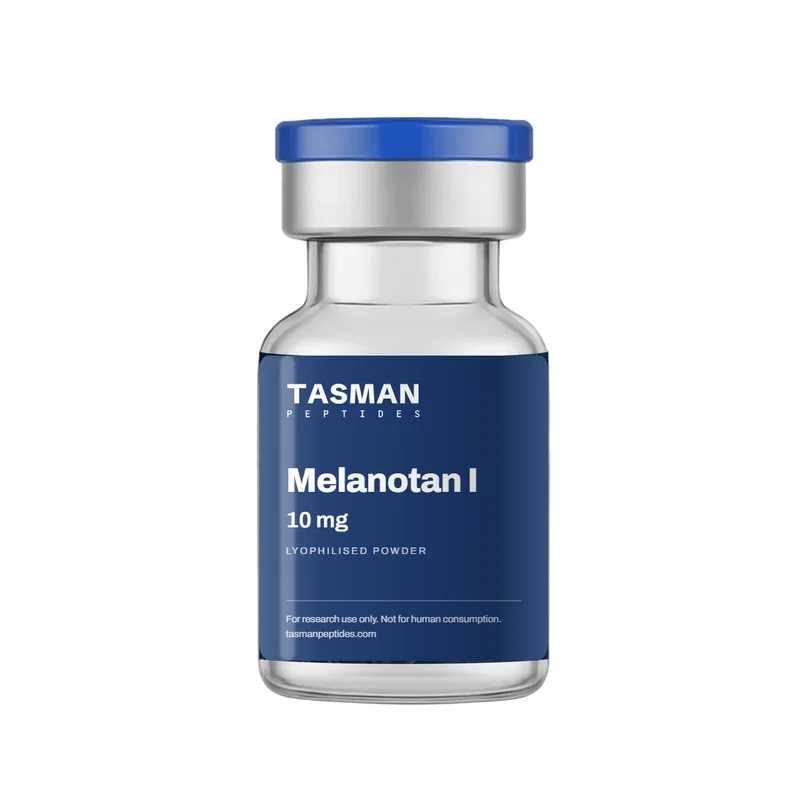
- Also known as
- MT-I · MT1 · Melanotan 1 · afamelanotide · NDP-MSH · [Nle4, D-Phe7]-α-MSH
- Class
- MC1R agonist (alpha-MSH analogue)
- Form
- Lyophilised powder (10 mg vial)
- Sizes
- 10 mg
- Storage, dry
- −20 °C, dry and dark
- Storage, mixed
- 2–8 °C, use within 28 days of mixing (as generally reported for reconstituted peptides)
- BAC water per size
- 10 mg: 2 mL
- Molecular weight
- 1646.9 g/mol
What is Melanotan I?
Melanotan I is a synthetic, linear 13-amino-acid analogue of alpha-melanocyte-stimulating hormone (alpha-MSH) in which norleucine replaces methionine at position 4 and D-phenylalanine replaces L-phenylalanine at position 7. The same sequence is called NDP-MSH in laboratory papers and afamelanotide as a drug substance. It binds the melanocortin-1 receptor (MC1R) and, according to the reviews here, has higher activity and stability than the natural hormone. MC1R signalling raises melanin synthesis and is linked to antioxidant, DNA-repair and anti-inflammatory effects. As a medicine, afamelanotide is given as a 16 mg controlled-release implant (Scenesse) for erythropoietic protoporphyria. Tasman's vial is the peptide as a dry research reagent. It is not Scenesse and is not a medicine.
What the research shows
| Study | Model | Dose used | Duration | Finding |
|---|---|---|---|---|
| Langendonk JG et al.2015 · N Engl J Med · PMID 26132941 | Human, two randomised double-blind placebo-controlled trials in erythropoietic protoporphyria (EU n=74, US n=94) | Afamelanotide 16 mg subcutaneous implant (Scenesse formulation) or placebo, every 60 days | 180 days (US, 3 implants) and 270 days (EU, 5 implants) | Median pain-free time in direct sunlight was longer with afamelanotide (US 69.4 vs 40.8 hours, P=0.04; EU 6.0 vs 0.8 hours, P=0.005), and the EU trial recorded fewer phototoxic reactions (77 vs 146). Adverse events were mostly mild. |
| Lengweiler S et al.2015 · Skin Pharmacol Physiol · PMID 25402764 | Human, erythropoietic protoporphyria patients in phase II/III trials (n=26), antibody assay | Not stated in the abstract (afamelanotide, Scenesse) | Up to 6 years of exposure | A new ELISA found no anti-drug antibodies in 23 of 26 patients. Three had pre-existing immunoreactivity to afamelanotide and alpha-MSH, and their titres did not change during treatment. |
| Böhm M et al.2014 · J Eur Acad Dermatol Venereol · PMID 22845050 | Human, phase II open-label pilot in acne vulgaris (n=3) | Afamelanotide 16 mg subcutaneous sustained-release resorbable implant | Assessed 56 days after the first implant | Total and inflammatory acne lesion counts fell in all 3 patients and quality-of-life scores improved. All 3 showed increased pigmentation, mainly on the face. |
| Biolcati G et al.2014 · Clin Exp Dermatol · PMID 24256215 | Cell culture (Hailey-Hailey lesion keratinocytes) plus human open-label pilot (n=2) | Patients: afamelanotide 16 mg subcutaneous sustained-release resorbable implant; cell dose not stated in the abstract | Assessed 30 and 60 days after the first implant | In lesion-derived keratinocytes, afamelanotide upregulated Nrf2 and restored defective proliferation. Both patients had 100% clearance of lesions at 60 days. |
| Lonati C et al.2021 · Peptides · PMID 33865932 | Rat, ex vivo lung perfusion after ischaemia/reperfusion or cardiac death (N=10 per protocol, 5 treated) | Not stated in the abstract (NDP-MSH given before lung procurement and during perfusion) | Not stated in the abstract | NDP-MSH lowered inflammatory mediators, leukocytes and lactate in perfusate, raised ATP in ischaemia/reperfusion lungs and improved vascular and airway measures in cardiac-death lungs. MC1R and MC5R were found in lung tissue. |
| Rennalls LP et al.2010 · Immunology · PMID 20074207 | Cell culture (human dendritic cells) | Not stated in the abstract | Not stated in the abstract | Dendritic cells expressed mRNA for all known melanocortin receptors. NDP-MSH reduced their ability to stimulate allogeneic T cells and lowered surface CD86, ICAM-1 and CD1a. |
| Jiang J et al.1995 · Pigment Cell Res · PMID 8789740 | Cell culture (17 human melanoma cell lines) | Not stated in the abstract | 72 hours, and 6 to 43 days in some lines | Only one melanotic line consistently raised tyrosinase activity. Cell numbers fell sharply in both melanotic and amelanotic lines, and growth inhibition persisted days after the peptide was removed. |
| Frändberg PA et al.1994 · Biochem Biophys Res Commun · PMID 8060302 | Cell culture (COS-7 cells expressing wild-type and mutant human MC1R) | Not applicable (receptor binding assay) | Not applicable | Single alanine mutations at Asp117 or His260 cut alpha-MSH binding affinity by 267-fold and 132-fold, while NDP-MSH affinity was unchanged, pointing to different attachment points for the two agonists. |
What these studies don't show: The human trials all used afamelanotide as the 16 mg Scenesse-type implant under medical supervision, so they say nothing about the peptide once it is reconstituted from a research vial or given by any other route. Outside erythropoietic protoporphyria, the human studies are open-label pilots with two or three patients. The NDP-MSH work is rat lung perfusion and cell culture. None of these records measured cosmetic tanning in healthy people.
Every study links to its PubMed record. See all Melanotan I studies in the research library →
Melanotan I price in Australia: 10mg vial
Buy Melanotan I in Australia in a 10mg vial and a starter kit. Prices are in AUD, you pay by PayID or bank transfer, and orders are dispatched from Australian stock.
| Size | Price | Per mg | BAC water (example) |
|---|---|---|---|
| 10 mg | $79.99 | $8.00/mg | 2 mL |
The BAC water column is an example volume for the maths only. Open the calculator (pre-set for Melanotan I).
Starter kit

Is Melanotan I available in Australia?
The drug form of this molecule, afamelanotide, is registered on the ARTG as Scenesse, a 16 mg implant for erythropoietic protoporphyria. Tasman's Melanotan I vial is not Scenesse: it is a lyophilised research reagent, and it is not a registered medicine. It is supplied for laboratory research only, not for human use. How the TGA treats research peptides →
Side effects reported in studies
In the randomised trials of the 16 mg afamelanotide implant, adverse events were mostly mild and serious events were not thought to be drug-related. Reviews name headache, fatigue, nausea and implant-site reactions as common, and increased skin pigmentation in almost all patients.
Reconstitution
| Vial | BAC water (example) | Concentration |
|---|---|---|
| 10 mg | 2 mL | 5 mg/mL |
Melanotan I FAQ
Where can I buy Melanotan I in Australia?
Tasman Peptides supplies research-grade Melanotan I from Australian stock, for laboratory research only. It comes as lyophilised powder in 10 mg vials, and each batch is tested by HPLC. It is not the Scenesse implant, it is not a registered medicine, and it is not sold for human use, including tanning.
How much is Melanotan I per mg?
The cost per mg is shown in the size table on this page. Melanotan I is sold as a single 10 mg lyophilised vial, so the vial price divided by 10 gives the price per mg of peptide.
Is Melanotan I the same as afamelanotide or Scenesse?
Melanotan I and afamelanotide are the same molecule, [Nle4, D-Phe7]-α-MSH, but a research vial is not Scenesse. Scenesse is a registered 16 mg controlled-release implant made for erythropoietic protoporphyria. Tasman's vial is the dry peptide as a laboratory reagent, with no implant matrix and no medicine registration.
Is Melanotan I legal in Australia?
Afamelanotide is registered on the ARTG as Scenesse for erythropoietic protoporphyria, but that registration covers only the Scenesse implant. Melanotan I sold as a research chemical is not a registered product and has no approved use. Tasman supplies it for laboratory research only.
How should Melanotan I be stored?
Store the dry powder at −20 °C, sealed, dry and away from light. Once reconstituted, keep it at 2–8 °C and use it within 28 days, as is generally reported for reconstituted peptides. Avoid repeated freezing and thawing of the solution.
Melanotan I vs Melanotan II: what is the difference?
Melanotan I is a linear 13-residue alpha-MSH analogue that acts mainly at the MC1 receptor. Melanotan II is a smaller cyclic peptide that activates several melanocortin receptors, including MC3R and MC4R. Melanotan I has randomised human trial data as the Scenesse implant, while Melanotan II's human data are mostly case reports.
What is Melanotan I studied for?
Melanotan I is studied mainly as an MC1 receptor agonist in pigmentation and light-sensitive skin disease. As the afamelanotide implant it was tested in erythropoietic protoporphyria, acne and Hailey-Hailey disease. As NDP-MSH it is a standard lab tool in receptor binding, dendritic cell, melanoma cell and rat lung perfusion studies.
What is NDP-MSH?
NDP-MSH is the laboratory name for [Nle4, D-Phe7]-α-MSH, the same peptide as Melanotan I and afamelanotide. The name is common in receptor pharmacology, where it is used as a potent reference agonist at melanocortin receptors, for example in MC1R binding and mutation studies.
Is there a Melanotan I starter kit?
Yes. The Melanotan I starter kit pairs the 10 mg vial with the bacteriostatic water and basic supplies needed to reconstitute it in the lab. The kit contents are listed on the kit page, and the site calculator works out concentration from the volume of water used.
How much bacteriostatic water goes with a 10 mg vial?
As a neutral arithmetic default, 2 mL of bacteriostatic water in a 10 mg vial gives 5 mg per mL. The volume is a lab choice that sets the concentration, and the calculator on this page does the maths for any volume.
Compare with
Related compounds
Melanotan II
Non-selective melanocortin receptor agonist (cyclic alpha-MSH analogue)
PT-141
Melanocortin receptor agonist (MC3R and MC4R; cyclic alpha-MSH analogue)
GHK-Cu
Copper-binding tripeptide (Gly-His-Lys copper complex)
KPV
Melanocortin-derived tripeptide (C-terminal fragment of α-MSH)