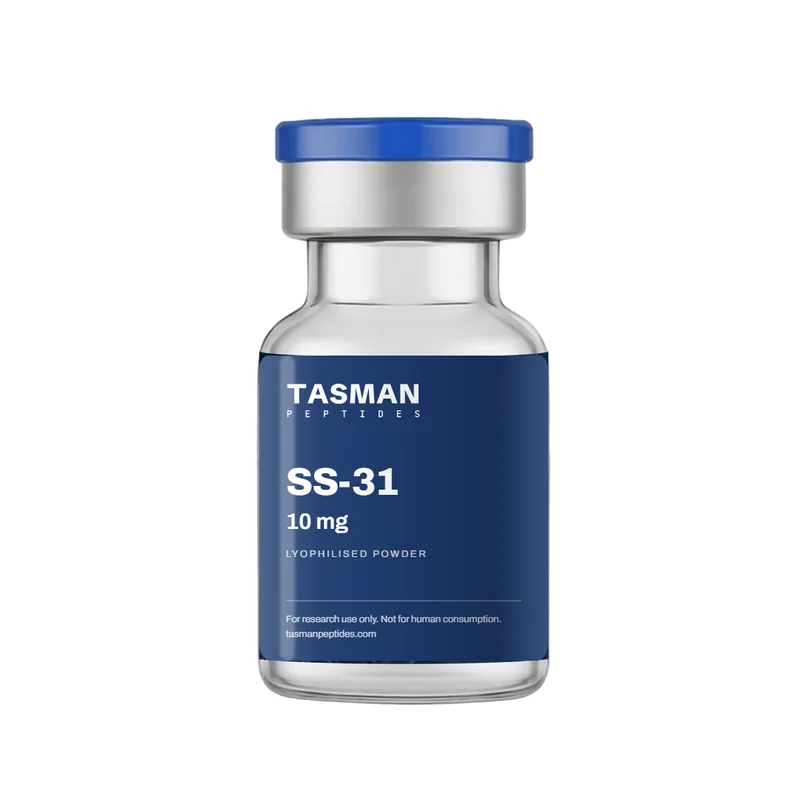
- Also known as
- Elamipretide · Bendavia · MTP-131 · SS31 · Szeto-Schiller peptide 31
- Class
- Mitochondria-targeting peptide (cardiolipin binder)
- Form
- Lyophilised powder (10 mg vial)
- Sizes
- 10 mg
- Storage, dry
- −20 °C, dry and dark
- Storage, mixed
- 2–8 °C, use within 28 days of mixing (as generally reported for reconstituted peptides)
- BAC water per size
- 10 mg: 2 mL
- Molecular weight
- 639.8 g/mol (C32H49N9O5)
What is SS-31?
SS-31 is a water-soluble, aromatic-cationic tetrapeptide that crosses the outer mitochondrial membrane and associates with cardiolipin, a phospholipid of the inner membrane. Reviews describe this binding as stabilising cristae structure, reducing oxidative stress and supporting ATP production. Its drug name is elamipretide, and it has also been called Bendavia and MTP-131. It has been through a full clinical programme: the TAZPOWER trial in Barth syndrome, the phase 3 MMPOWER-3 trial in primary mitochondrial myopathy, and heart failure and eye studies. In September 2025 it received accelerated approval in the USA, as Forzinity, to improve muscle strength in Barth syndrome. Animal work covers mitochondrial trifunctional protein deficiency, ozone airway injury and traumatic optic neuropathy in mice.
What the research shows
| Study | Model | Dose used | Duration | Finding |
|---|---|---|---|---|
| Karaa A et al.2023 · Neurology · PMID 37268435 | Human, phase 3 randomised double-blind placebo-controlled trial, primary mitochondrial myopathy (n=218) | 40 mg/day subcutaneous | 24 weeks | The trial did not meet its primary endpoints: the difference from placebo was -3.2 m on the 6-minute walk test (p = 0.69) and -0.07 on total fatigue (p = 0.37). Elamipretide was well tolerated, with most adverse events mild to moderate. |
| Karaa A et al.2024 · Orphanet J Rare Dis · PMID 39574155 | Human, post hoc analysis of the MMPOWER-3 randomised trial by genotype | Not stated in the abstract (MMPOWER-3 treatment arms) | 24 weeks | Patients with mtDNA replisome variants improved 25.2 m on the 6-minute walk test versus 2.0 m on placebo (p = 0.06). Within that group, those with CPEO improved 37.3 m versus -8.0 m (p = 0.0024). |
| Thompson WR et al.2024 · Genet Med · PMID 38602181 | Human, open-label extension of the TAZPOWER randomised trial, Barth syndrome (n=10 entered, 8 reached week 168) | 40 mg subcutaneous daily | 168-week open-label extension after a 28-week randomised phase | The 6-minute walk test improved at every time point, by a cumulative 96.1 m at week 168 (P = .003), and fatigue scores stayed below baseline. Injection-site reactions were the most common adverse events. |
| Hornby B et al.2022 · Orphanet J Rare Dis · PMID 36056411 | Human, retrospective natural history comparison, Barth syndrome (8 treated patients vs 19 untreated controls) | 40 mg daily | Compared at weeks 64 and 76 | The 6-minute walk test favoured elamipretide by 79.7 m at week 64 and 91.0 m at week 76, with gains in handheld muscle strength. Left ventricular stroke volume rose in treated patients and fell in the untreated controls. |
| Vieira Neto E et al.2026 · J Inherit Metab Dis · PMID 41500837 | Mouse, βTFP-deficient (mitochondrial trifunctional protein deficiency); patient-derived fibroblasts | Delivered by osmotic minipump; amount not stated in the abstract | Not stated in the abstract | Treated βTFP-deficient mice showed better exercise endurance but no change in cold tolerance, and liver mitochondria had improved FAO-ETC enzyme activity. Cardiolipin content and composition did not change. |
| Xie M et al.2026 · Lung · PMID 41801306 | Mouse, ozone-induced airway injury (C57BL/6J); BEAS-2B airway cells | Intraperitoneal, 1 h before ozone exposure; amount not stated in the abstract | Single ozone exposure | SS-31 and N-acetylcysteine comparably reduced airway hyperresponsiveness, inflammatory cell influx and mucus hypersecretion. Both lowered ROS and malondialdehyde and improved SOD activity and GSH/GSSG. |
| Tse BC et al.2020 · Exp Eye Res · PMID 32758490 | Mouse, sonication-induced traumatic optic neuropathy | Intravitreal and/or subcutaneous MTP-131; amount not stated in the abstract | Not stated in the abstract | Subcutaneous MTP-131 alone raised retinal ganglion cell survival by 17% over controls (p < 0.01). Combining it with etanercept gave no synergistic effect. |
What these studies don't show: The largest trial, MMPOWER-3, missed both primary endpoints, and the positive signals in mitochondrial myopathy come from post hoc subgroups. The Barth syndrome results come from about ten patients in an open-label extension and a comparison with historical controls, not a large blinded trial. The mouse studies do not state doses, and the long-term safety of elamipretide is still described as needing more study.
Every study links to its PubMed record. See all SS-31 studies in the research library →
SS-31 price in Australia: 10mg vial
Buy SS-31 in Australia in a 10mg vial and a starter kit. Prices are in AUD, you pay by PayID or bank transfer, and orders are dispatched from Australian stock.
| Size | Price | Per mg | BAC water (example) |
|---|---|---|---|
| 10 mg | $89.99 | $9.00/mg | 2 mL |
The BAC water column is an example volume for the maths only. Open the calculator (pre-set for SS-31).
Starter kit
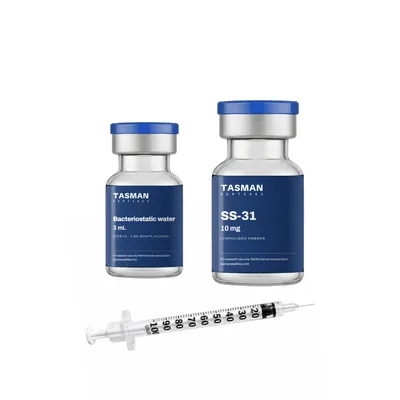
Is SS-31 available in Australia?
SS-31 (elamipretide) is not registered on the ARTG, and there is no TGA-approved elamipretide product in Australia. It received accelerated approval in the USA in September 2025, as Forzinity for Barth syndrome, but that approval does not apply here. Tasman supplies SS-31 as a research chemical for laboratory research only, not for human or veterinary use. How the TGA treats research peptides →
Side effects reported in studies
In the phase 3 MMPOWER-3 trial (n=218), elamipretide was well tolerated and most adverse events were mild to moderate; in the Barth syndrome extension, injection-site reactions were the most common adverse events. A review of early heart failure trials reports no severe adverse events.
Reconstitution
| Vial | BAC water (example) | Concentration |
|---|---|---|
| 10 mg | 2 mL | 5 mg/mL |
SS-31 FAQ
Where can I buy SS-31 in Australia?
Tasman supplies research-grade SS-31 from Australian stock as a 10 mg lyophilised vial. Each batch is tested by HPLC before dispatch. It is sold for laboratory research only, not for human or veterinary use, and SS-31 (elamipretide) is not registered on the ARTG.
Is SS-31 the same as elamipretide?
Yes. SS-31 is the research name of the peptide whose drug name is elamipretide, and it has also been called Bendavia and MTP-131. The US-approved product is sold as Forzinity. All of these refer to the same tetrapeptide, D-Arg-Dmt-Lys-Phe-NH2.
What is SS-31 studied for?
SS-31 is studied for disorders of mitochondrial function. The main human work is in Barth syndrome, primary mitochondrial myopathy and heart failure, with phase 3 development also listed for dry age-related macular degeneration. Mouse studies cover trifunctional protein deficiency, ozone airway injury, traumatic optic neuropathy and kidney injury.
How does SS-31 work?
SS-31 crosses into mitochondria and binds cardiolipin, a phospholipid of the inner mitochondrial membrane. Reviews describe this as stabilising cristae structure, reducing oxidative stress and improving ATP production. Newer work also points to effects on membrane electrostatic potential and on the assembly of cardiolipin-dependent proteins.
Is SS-31 legal in Australia?
SS-31 (elamipretide) is not registered on the ARTG, and there is no TGA-approved product. It received accelerated approval in the USA in September 2025 for Barth syndrome, but that has no bearing on its status in Australia. Tasman supplies it only as a research chemical for laboratory use.
What dose of SS-31 was used in trials?
The human trials in this record used 40 mg of elamipretide once daily by subcutaneous injection, for 24 weeks in MMPOWER-3 and up to 168 weeks in the TAZPOWER extension. That is the dose those studies used, reported for reference. Tasman does not publish dosing guidance.
Did SS-31 work in mitochondrial myopathy?
Not overall. The phase 3 MMPOWER-3 trial in 218 adults did not meet its primary endpoints on walking distance or fatigue. A post hoc analysis found a larger 6-minute walk gain in patients with mtDNA replisome variants, which led to a follow-up phase 3 trial called NuPOWER.
How much is SS-31 per mg?
The size table on this page lists the 10 mg vial with its current price, so the cost per mg can be read straight from it. The vial is lyophilised powder, and the site's calculator works out the reconstitution maths for any chosen volume of bacteriostatic water.
How should SS-31 be stored?
Store the dry powder at −20 °C, sealed, dry and away from light. Once reconstituted, keep it at 2–8 °C and use it within 28 days, as is generally reported for reconstituted peptides. Avoid repeated freezing and thawing of the solution.
Is there an SS-31 starter kit?
Yes. The SS-31 10 mg vial is also offered as a starter kit, and the product page lists exactly what the kit includes. Like the vial on its own, the kit is supplied for laboratory research only.