
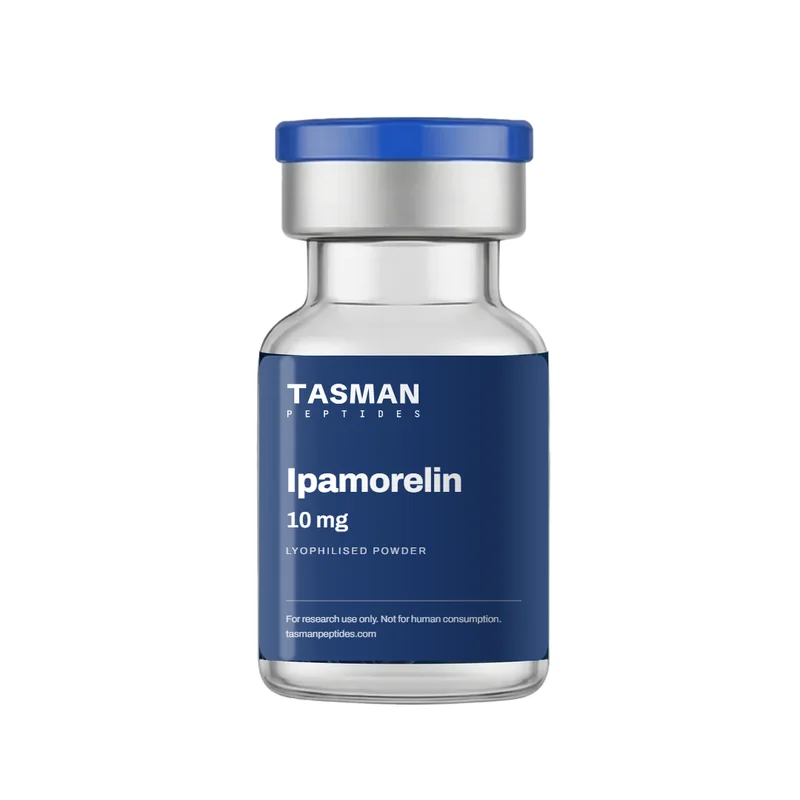
- Also known as
- Ipamorelin acetate · NNC 26-0161 · IPA
- Class
- Growth hormone secretagogue, ghrelin (GHS-R1a) receptor agonist
- Form
- Lyophilised powder
- Sizes
- 10 mg
- Storage, dry
- −20 °C, dry and dark
- Storage, mixed
- 2–8 °C, use within 28 days of mixing (as generally reported for reconstituted peptides)
- BAC water per size
- 10 mg: 2 mL
What is Ipamorelin?
Ipamorelin is a synthetic pentapeptide (Aib-His-D-2-Nal-D-Phe-Lys-NH2) that acts on the growth hormone secretagogue receptor, also called the ghrelin receptor. It came out of a 1990s chemistry programme on compounds derived from GHRP-1 and was described in 1998 as the first selective growth hormone secretagogue. In rats and pigs it released growth hormone about as strongly as GHRP-6, but unlike GHRP-6 and GHRP-2 it did not raise ACTH or cortisol, even at doses more than 200 times the dose needed for half its growth hormone effect. Because the ghrelin receptor also affects gut motility, it was later tested in rats and in one human phase 2 trial for postoperative ileus. Most of the published work is in rodents, and the human data are limited to short studies.
What the research shows
| Study | Model | Dose used | Duration | Finding |
|---|---|---|---|---|
| Beck DE et al.2014 · Int J Colorectal Dis · PMID 25331030 | Human, randomised, double-blind, placebo-controlled phase 2 trial in adults after bowel resection (n=114 in the safety population) | 0.03 mg/kg by intravenous infusion, twice daily | Postoperative day 1 to 7 or hospital discharge | Treatment-emergent adverse events occurred in 87.5% of the ipamorelin group and 94.8% of the placebo group. Median time to the first tolerated solid meal was 25.3 h vs 32.6 h (p = 0.15), and there were no significant differences in the key or secondary efficacy analyses. |
| Gobburu JV et al.1999 · Pharm Res · PMID 10496658 | Human, healthy male volunteers, dose-escalation pharmacokinetic study (8 subjects at each of 5 dose levels) | 4.21, 14.02, 42.13, 84.27 and 140.45 nmol/kg infused over 15 minutes | Single infusion | Pharmacokinetics were dose-proportional, with a terminal half-life of 2 hours. Each dose produced a single episode of growth hormone release peaking at 0.67 hours, then declining to negligible levels. |
| Raun K et al.1998 · Eur J Endocrinol · PMID 9849822 | Primary rat pituitary cells, anaesthetised rats and conscious swine | Not stated in the abstract (dose-response; ED50 of 80 nmol/kg in rats and 2.3 nmol/kg in swine) | Acute dosing | Ipamorelin released growth hormone with potency and efficacy similar to GHRP-6. In swine it did not affect FSH, LH, prolactin or TSH, and unlike GHRP-6 and GHRP-2 it did not raise ACTH or cortisol, even at doses more than 200-fold above the ED50. |
| Venkova K et al.2009 · J Pharmacol Exp Ther · PMID 19289567 | Rat, postoperative ileus model (laparotomy and intestinal manipulation) | 0.01–1 mg/kg intravenous bolus | Single dose, or 2 days of repeated dosing (four doses a day at 3-h intervals) | A single 1 mg/kg dose shortened the time to first bowel movement. Repeated dosing at 0.1 or 1 mg/kg significantly increased cumulative faecal pellet output, food intake and body weight gain over 48 h. |
| Greenwood-Van Meerveld B et al.2012 · J Exp Pharmacol · PMID 27186127 | Rat, postoperative ileus model, plus isolated gastric fundus tissue | 0.014–0.14 µmol/kg intravenous; 1 µM in the organ bath | Single dose | After surgery, 78% of a test meal remained in the stomach of vehicle-treated rats compared with 52% after ipamorelin 0.014 µmol/kg (P < 0.05). Ipamorelin also reversed the loss of gastric muscle contractility caused by the surgery. |
| Johansen PB et al.1999 · Growth Horm IGF Res · PMID 10373343 | Rat, adult females | 18, 90 and 450 micrograms/day, s.c., split over three injections a day | 15 days | Longitudinal bone growth rose dose-dependently from 42 micrometres/day with vehicle to 44, 50 and 52 micrometres/day (P < 0.0001), with a dose-dependent gain in body weight. Total IGF-I, IGFBPs and serum bone-turnover markers did not change. |
| Svensson J et al.2000 · J Endocrinol · PMID 10828840 | Rat, young adult females (n=7 for ipamorelin) | 0.5 mg/kg per day, continuous s.c. infusion by osmotic minipump | 12 weeks | Ipamorelin, GHRP-6 and GH all increased body weight and tibial and vertebral bone mineral content. Bone mineral content corrected for body weight was unchanged, and the authors attributed the increase to larger bone dimensions rather than denser bone. |
| Andersen NB et al.2001 · Growth Horm IGF Res · PMID 11735244 | Rat, 8-month-old females given the glucocorticoid methylprednisolone | 100 micrograms/kg s.c., three times daily | 3 months | Given with the glucocorticoid, ipamorelin significantly increased maximum tetanic tension of the calf muscles, and periosteal bone formation rate was four-fold higher than with the glucocorticoid alone. |
What these studies don't show: The only controlled human trial here is a small phase 2 study in post-surgical patients, and it found no significant benefit over placebo on its efficacy endpoints. The other human study measured pharmacokinetics and growth hormone release after a single infusion in healthy men. The bone, muscle and growth results come from rats, and there are no long-term human data on repeated use.
Every study links to its PubMed record. See all Ipamorelin studies in the research library →
Ipamorelin price in Australia: 10mg vial
Buy Ipamorelin in Australia in a 10mg vial and a starter kit. Prices are in AUD, you pay by PayID or bank transfer, and orders are dispatched from Australian stock.
| Size | Price | Per mg | BAC water (example) |
|---|---|---|---|
| 10 mg | $89.99 | $9.00/mg | 2 mL |
The BAC water column is an example volume for the maths only. Open the calculator (pre-set for Ipamorelin).
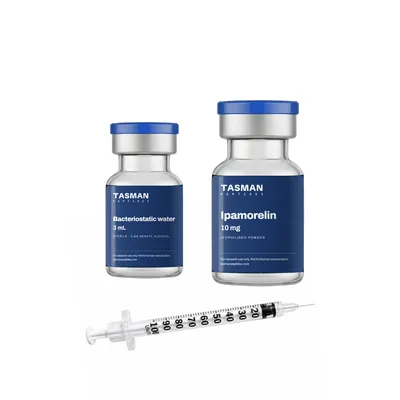
Starter kit
Is Ipamorelin available in Australia?
Ipamorelin is not registered on the ARTG, and there is no TGA-approved product containing it. Tasman Peptides supplies it as a research chemical for laboratory research only. It is not sold for human consumption. How the TGA treats research peptides →
Side effects reported in studies
In the one placebo-controlled human trial, adverse events were reported in 87.5% of patients given ipamorelin and 94.8% given placebo, and the authors described it as well tolerated. The abstract does not list individual events, and the trial found no significant efficacy difference from placebo. Read more →
Doses used in studies
The human doses reported were 0.03 mg/kg by intravenous infusion twice daily for up to 7 days (Beck et al. 2014) and single 15-minute infusions of 4.21–140.45 nmol/kg (Gobburu et al. 1999). Rat studies used intravenous doses of 0.01–1 mg/kg and subcutaneous doses of 18–450 micrograms/day or 100 micrograms/kg three times daily. Read more →
Reconstitution
| Vial | BAC water (example) | Concentration |
|---|---|---|
| 10 mg | 2 mL | 5 mg/mL |
Ipamorelin FAQ
Where can I buy ipamorelin in Australia?
Tasman Peptides supplies research-grade ipamorelin in Australia for laboratory research only. It comes as lyophilised powder in a 10 mg vial, each batch is tested by HPLC, and orders are dispatched from Australian stock. It is not sold for human consumption and is not a TGA-approved product.
What is ipamorelin studied for?
Ipamorelin is mainly studied for how it releases growth hormone through the ghrelin receptor without raising cortisol, and for its effects on gut motility. Published work covers growth hormone release in rats, pigs and healthy men, postoperative ileus in rats and one human phase 2 trial, and bone growth and bone mineral content in rats.
What dose of ipamorelin was used in human studies?
The human studies used intravenous infusion. A phase 2 trial in bowel-surgery patients used 0.03 mg/kg twice daily for up to 7 days (Beck et al. 2014), and a pharmacokinetic study gave single 15-minute infusions of 4.21 to 140.45 nmol/kg to healthy men (Gobburu et al. 1999). The dosage page lists every study dose with its source.
What are the side effects of ipamorelin?
In the only placebo-controlled human trial, adverse events were reported in 87.5% of patients given ipamorelin and 94.8% given placebo, and the authors described it as well tolerated. The abstract does not list individual events. In swine, ipamorelin did not raise ACTH or cortisol, unlike GHRP-6 and GHRP-2.
How much is ipamorelin per mg?
Ipamorelin is sold as a 10 mg vial, and the current price is shown in the size table on this page. Dividing the vial price by 10 gives the price per mg. The starter kit and the CJC-1295 + ipamorelin blend are priced separately.
Is there an ipamorelin starter kit?
Yes, there is an ipamorelin starter kit. It is built around the 10 mg vial, and the kit page lists exactly what it includes. Like the vial, it is supplied for laboratory research only.
How should ipamorelin be stored?
Store the dry powder at −20 °C, sealed, dry and away from light. Once reconstituted, keep it at 2–8 °C and use it within 28 days, as is generally reported for reconstituted peptides. Avoid repeated freezing and thawing of a mixed solution.
Is ipamorelin legal in Australia?
Ipamorelin is not registered on the ARTG and there is no TGA-approved product containing it. Tasman Peptides supplies it as a research chemical for laboratory research only. In sport, growth hormone releasing peptides are on the WADA Prohibited List, and anti-doping methods can detect ipamorelin metabolites in urine.
What is the difference between ipamorelin and tesamorelin?
Ipamorelin and tesamorelin act on different receptors. Ipamorelin is a five-amino-acid agonist of the ghrelin (growth hormone secretagogue) receptor, while tesamorelin is a 44-amino-acid analogue of growth hormone-releasing hormone that acts on the GHRH receptor. Tesamorelin's evidence comes mostly from human trials in HIV-associated abdominal fat; ipamorelin's is mostly from rats.
Why is ipamorelin paired with CJC-1295?
Ipamorelin is paired with CJC-1295 because they release growth hormone through two different receptors: ipamorelin through the ghrelin receptor and CJC-1295 through the GHRH receptor. None of the studies in our ipamorelin records tested the pair together, so there is no published combined result here. Tasman supplies a premixed 10 mg research vial of CJC-1295 (no DAC) 5 mg with ipamorelin 5 mg.
Compare with
Related compounds
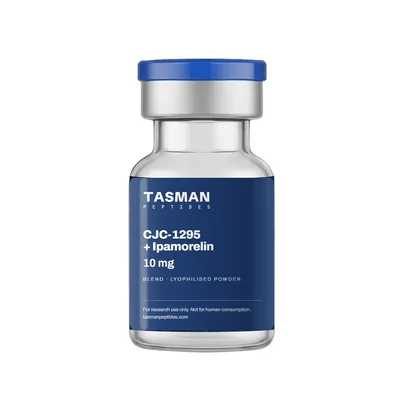
CJC-1295 + Ipamorelin
Two-peptide research blend: a GHRH analogue and a ghrelin receptor (GHS-R) agonist
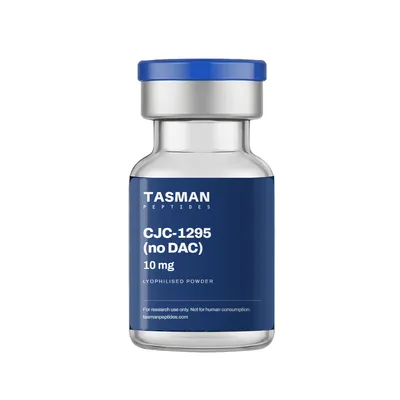
CJC-1295 (no DAC)
Growth hormone-releasing hormone (GHRH) analogue
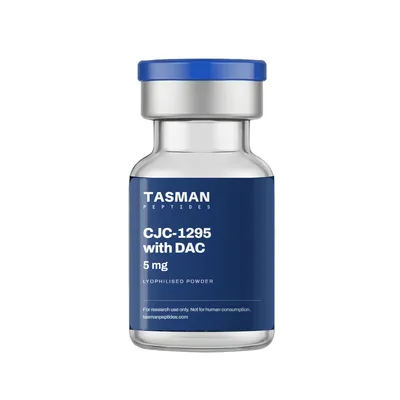
CJC-1295 with DAC
Long-acting growth hormone-releasing hormone (GHRH) analogue