
- Also known as
- Cagri · cagrilintide peptide · long-acting amylin analogue · CagriSema component
- Class
- Long-acting amylin analogue
- Form
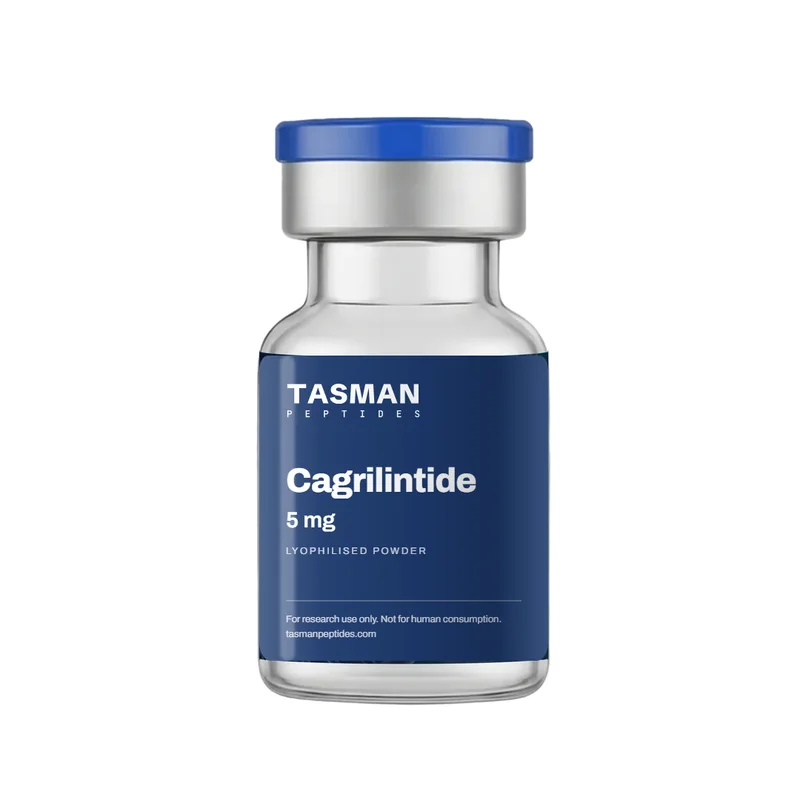
- Lyophilised powder, 5 mg or 10 mg vial
- Sizes
- 5 mg · 10 mg
- Storage, dry
- −20 °C, dry and dark
- Storage, mixed
- 2–8 °C, use within 28 days of mixing (as generally reported for reconstituted peptides)
- BAC water per size
- 5 mg: 2 mL · 10 mg: 2 mL
What is Cagrilintide?
Cagrilintide is a synthetic, long-acting analogue of amylin, a pancreatic hormone that induces satiety. It acts at the amylin receptor and was built to last long enough for once-weekly subcutaneous dosing in trials. It has been studied in two ways. As a single agent, a 26-week phase 2 trial in adults with overweight or obesity compared five weekly doses with placebo and with liraglutide. Most of the later work tests it alongside semaglutide, a GLP-1 receptor agonist, as a fixed-dose combination called CagriSema; the phase 3 REDEFINE and REIMAGINE programmes studied that combination in obesity and type 2 diabetes. The two drugs act on different receptors, which is the rationale the trial authors give for pairing them. Phase 1 studies have also looked at its pharmacokinetics, heart rhythm (QT interval) and handling in kidney or liver impairment.
What the research shows
| Study | Model | Dose used | Duration | Finding |
|---|---|---|---|---|
| Lau DCW et al.2021 · Lancet · PMID 34798060 | Human, phase 2 randomised controlled trial, cagrilintide alone, adults with overweight or obesity without diabetes (n=906 randomised: 706 cagrilintide, 99 liraglutide, 101 placebo) | Cagrilintide 0.3, 0.6, 1.2, 2.4 or 4.5 mg once weekly, subcutaneous; comparator liraglutide 3.0 mg once daily | 26 weeks treatment (including up to 6 weeks escalation), plus 6 weeks follow-up | Mean weight reduction was 6.0%–10.8% across the cagrilintide doses versus 3.0% with placebo (trial product estimand). Cagrilintide 4.5 mg reduced weight by 10.8% compared with 9.0% for liraglutide 3.0 mg. |
| Gabe MBN et al.2024 · Diabetes Obes Metab · PMID 39279639 | Human, randomised double-blind thorough QT study, cagrilintide alone, healthy participants (n=105) | Cagrilintide once weekly subcutaneous, escalated to 4.5 mg; placebo arms received moxifloxacin 400 mg as a positive control | Not stated in the abstract | No clinically relevant QTcF prolongation occurred after the last 4.5 mg dose; the upper limits of the 90% confidence intervals of the placebo-adjusted changes were below 10 ms at all time points. |
| Enebo LB et al.2021 · Lancet · PMID 33894838 | Human, phase 1b randomised placebo-controlled trial, cagrilintide + semaglutide 2.4 mg, otherwise healthy adults with BMI 27.0–39.9 (n=96 randomised, 95 exposed) | Cagrilintide 0.16, 0.30, 0.60, 1.2, 2.4 or 4.5 mg or placebo, each with semaglutide 2.4 mg, once weekly subcutaneous | Co-escalation over 16 weeks, 4 weeks at target dose, then 5 weeks follow-up | The primary endpoint was the number of treatment-emergent adverse events; 566 adverse events were reported in 92 participants. Pharmacokinetics, body weight, glycaemic measures and hormones were secondary or exploratory endpoints. |
| Frias JP et al.2023 · Lancet · PMID 37364590 | Human, phase 2 randomised double-blind trial, CagriSema vs semaglutide vs cagrilintide, type 2 diabetes on metformin (n=92) | CagriSema, semaglutide or cagrilintide, each escalated to 2.4 mg once weekly subcutaneous | 32 weeks | HbA1c fell by 2.2 points with CagriSema, 1.8 with semaglutide and 0.9 with cagrilintide alone. Body weight fell by 15.6%, 5.1% and 8.1% respectively; CagriSema beat both single agents on weight. |
| Garvey WT et al.2025 · N Engl J Med · PMID 40544433 | Human, phase 3a randomised controlled trial (REDEFINE 1), CagriSema vs each component vs placebo, adults with overweight or obesity without diabetes (n=3417) | Cagrilintide 2.4 mg + semaglutide 2.4 mg, semaglutide 2.4 mg, cagrilintide 2.4 mg, or placebo, once weekly | 68 weeks | Mean body weight change was −20.4% with CagriSema versus −3.0% with placebo (difference −17.3 percentage points). The abstract does not report the result for the cagrilintide-alone arm. |
| Davies MJ et al.2025 · N Engl J Med · PMID 40544432 | Human, phase 3a randomised placebo-controlled trial (REDEFINE 2), CagriSema, adults with overweight or obesity and type 2 diabetes (n=1206) | Cagrilintide 2.4 mg + semaglutide 2.4 mg or placebo, once weekly | 68 weeks | Mean body weight change was −13.7% with CagriSema versus −3.4% with placebo. HbA1c of 6.5% or less was reached by 73.5% versus 15.9%. |
| Yamauchi T et al.2026 · Lancet Diabetes Endocrinol · PMID 42009015 | Human, phase 3a randomised active-controlled trial (REDEFINE 5), CagriSema vs semaglutide, adults in Japan and Taiwan with or without type 2 diabetes (n=331) | Cagrilintide + semaglutide or semaglutide alone, both escalated to 2.4 mg once weekly subcutaneous | 68 weeks | Mean body weight change was −18.4% with CagriSema versus −11.9% with semaglutide alone (difference −6.5 percentage points). |
| Rosenstock J et al.2026 · Lancet · PMID 42251856 | Human, phase 3a randomised placebo-controlled trial (REIMAGINE 3), CagriSema added to basal insulin, type 2 diabetes (n=274) | Cagrilintide 2.4 mg + semaglutide 2.4 mg, or 1.0 mg + 1.0 mg, or dose-matched placebo, once weekly subcutaneous | 40 weeks | HbA1c fell by 2.33 points (2.4 mg each) and 2.10 points (1.0 mg each) versus 0.66 points with placebo. |
What these studies don't show: Almost all of the large trials tested cagrilintide combined with semaglutide, so their results describe CagriSema, not cagrilintide on its own. The only monotherapy efficacy data here are a 26-week phase 2 trial and the cagrilintide arms of combination trials, whose results the abstracts often do not report. The longest follow-up on file is 68 weeks, and the REDEFINE 1 and 2 abstracts name Novo Nordisk as the funder. No study on file used a research-grade compound or a combined retatrutide-cagrilintide preparation.
Every study links to its PubMed record. See all Cagrilintide studies in the research library →
Cagrilintide price in Australia: 5mg and 10mg vials
Buy Cagrilintide in Australia in 2 vial sizes and a starter kit. Prices are in AUD, you pay by PayID or bank transfer, and orders are dispatched from Australian stock.
| Size | Price | Per mg | BAC water (example) |
|---|---|---|---|
| 5 mg | $129.99 | $26.00/mg | 2 mL |
| 10 mg | $229.99 | $23.00/mg | 2 mL |
The BAC water column is an example volume for the maths only. Open the calculator (pre-set for Cagrilintide).
Starter kit
Is Cagrilintide available in Australia?
Cagrilintide is not registered on the ARTG, and there is no TGA-approved product containing it, either alone or as CagriSema. It remains an investigational compound in overseas clinical trials. Tasman Peptides supplies it as a research chemical for laboratory use only, not as a medicine. How the TGA treats research peptides →
Side effects reported in studies
Gastrointestinal events were the most common adverse events in the cagrilintide trials, mostly in CagriSema arms: 79.6% versus 39.9% on placebo in REDEFINE 1, described as mainly transient and mild to moderate. Single-agent phase 1 studies found no clinically relevant QT prolongation and no serious adverse events in people with kidney or liver impairment.
Doses used in studies
Studies of cagrilintide alone used once-weekly subcutaneous doses from 0.16 mg to 4.5 mg, and single doses of 0.6 or 0.9 mg in pharmacokinetic work. The CagriSema trials used cagrilintide 2.4 mg with semaglutide 2.4 mg, and some also tested 1.0 mg of each, after a dose-escalation period. These are reported study doses only. Read more →
Reconstitution
| Vial | BAC water (example) | Concentration |
|---|---|---|
| 5 mg | 2 mL | 2.50 mg/mL |
| 10 mg | 2 mL | 5 mg/mL |
Cagrilintide FAQ
Where can I buy cagrilintide in Australia?
Tasman Peptides supplies research-grade cagrilintide in 5 mg and 10 mg vials, dispatched from Australian stock. It is sold for laboratory research only, not as a medicine or for human use. It is tested by HPLC, and the purity result is shown on the product page.
How much is cagrilintide per mg?
The cost per mg is shown in the size table on this page. Cagrilintide comes in 5 mg and 10 mg vials, and the table lists each vial and the starter kit so the per-mg figure can be compared directly between sizes.
What is the difference between the 5 mg and 10 mg cagrilintide vials?
The only difference is the amount of cagrilintide in the vial. Both are the same lyophilised powder with the same HPLC testing. The larger vial suits longer or larger lab runs, and at the site's default of 2 mL bacteriostatic water it gives twice the concentration per mL of the 5 mg vial.
What is cagrilintide studied for?
Cagrilintide has been studied for weight management and, combined with semaglutide as CagriSema, for type 2 diabetes. A 26-week phase 2 trial tested it alone in adults with overweight or obesity. The phase 3 REDEFINE and REIMAGINE trials measured body weight, HbA1c and blood pressure with the combination, and phase 1 studies looked at QT interval and pharmacokinetics.
What is the difference between cagrilintide and CagriSema?
Cagrilintide is a single compound, a long-acting amylin analogue. CagriSema is the name used in trials for cagrilintide given together with semaglutide, a GLP-1 receptor agonist, usually at 2.4 mg of each once weekly. Most of the large trial results published so far describe CagriSema, not cagrilintide on its own.
Is cagrilintide legal in Australia?
Cagrilintide is not registered on the ARTG, and there is no TGA-approved product containing it, alone or as CagriSema. It is still investigational. Tasman supplies it only as a research chemical for laboratory work, not for human use.
Cagrilintide vs retatrutide: what is the difference?
They act on different targets. Cagrilintide is an amylin receptor agonist. Retatrutide is a single peptide that acts at the GIP, GLP-1 and glucagon receptors. Cagrilintide's large trials mostly pair it with semaglutide, while retatrutide is studied on its own. See the comparison page for the studies behind each.
Cagrilintide vs tirzepatide: what is the difference?
Tirzepatide is a GIP and GLP-1 receptor agonist and is registered on the ARTG as Mounjaro, a prescription medicine. Cagrilintide is an amylin analogue that is not registered in Australia. Trials of cagrilintide mostly test it with semaglutide, so the two are rarely compared as single agents.
How should cagrilintide be stored?
Store the dry powder at −20 °C, sealed and away from light. Once reconstituted, keep it at 2–8 °C and use it within about 28 days, which is the figure generally reported for reconstituted peptides. Avoid repeated freezing and thawing of mixed solution.
What comes in the cagrilintide starter kit?
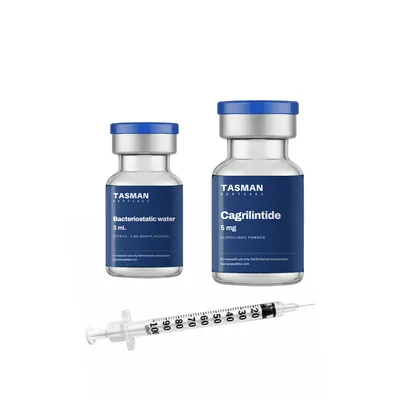
The cagrilintide starter kit contains one 5 mg vial, 3 mL of bacteriostatic water, ten 0.5 mL insulin syringes and 20 alcohol swabs. It groups the reconstitution supplies for bench work in one order. The vial is the same product sold on its own.
Compare with
Related compounds
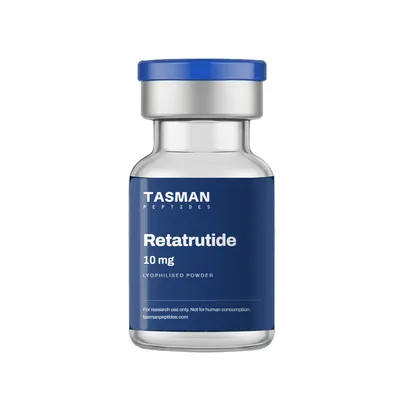
Retatrutide
GIP, GLP-1 and glucagon receptor agonist
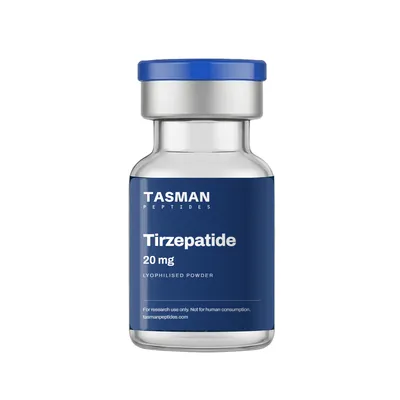
Tirzepatide
GIP and GLP-1 receptor agonist
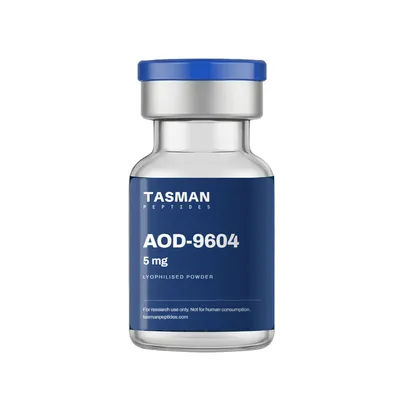
AOD-9604
Modified C-terminal fragment of human growth hormone
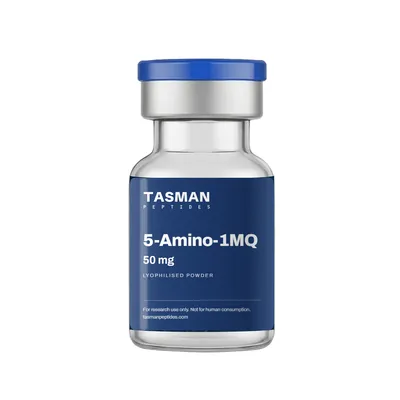
5-Amino-1MQ
Small-molecule nicotinamide N-methyltransferase (NNMT) inhibitor