
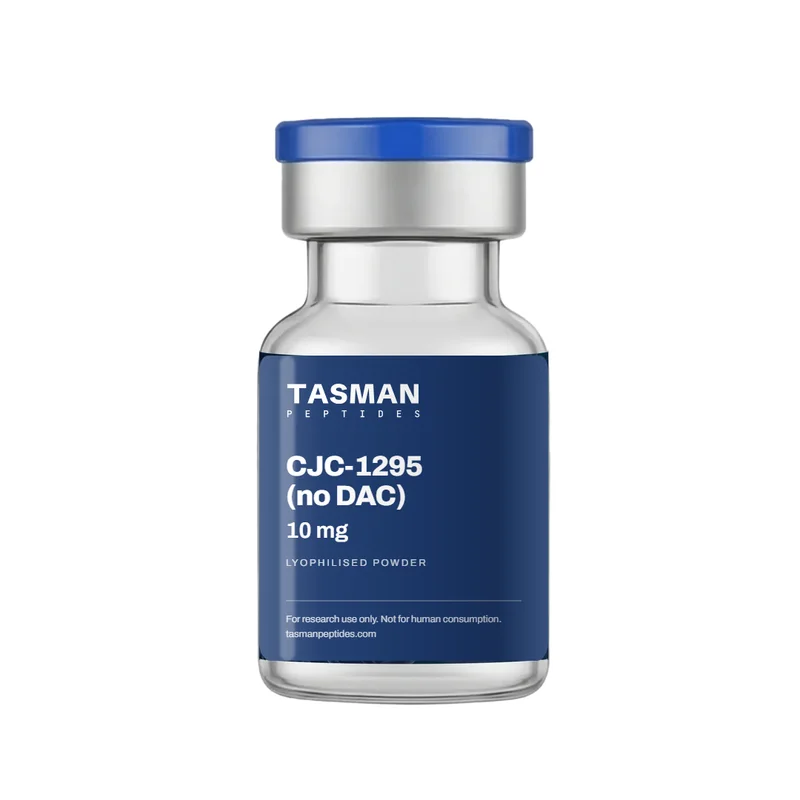
- Also known as
- Mod GRF 1-29 · Modified GRF (1-29) · CJC-1295 no DAC · tetrasubstituted GRF(1-29)
- Class
- GHRH analogue (modified GRF 1-29)
- Form
- Lyophilised powder
- Sizes
- 10 mg
- Storage, dry
- −20 °C, dry and dark
- Storage, mixed
- 2–8 °C, use within 28 days of mixing (as generally reported for reconstituted peptides)
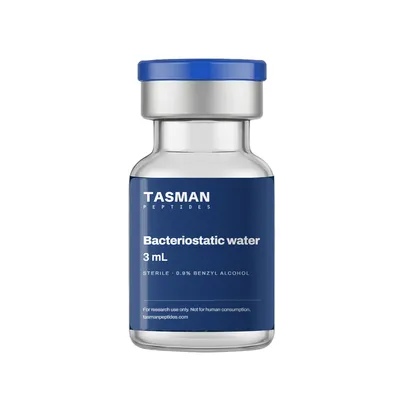
- BAC water per size
- 10 mg: 2 mL
What is CJC-1295 (no DAC)?
CJC-1295 without DAC is a synthetic analogue of the first 29 amino acids of human growth hormone-releasing hormone, the part of the hormone that carries its activity at the pituitary GHRH receptor. Four amino acids are swapped to make the chain more resistant to enzyme breakdown, which is why it is also called Mod GRF 1-29. It has no drug affinity complex (DAC), the reactive lysine group that lets the DAC version bind to albumin in the blood. Without that group it is expected to act for a short time, much closer to native GRF(1-29), whose plasma half-life in rats was about 10 minutes. Almost all published human data on 'CJC-1295' used the DAC version, so this page labels each study by the molecule it tested.
What the research shows
| Study | Model | Dose used | Duration | Finding |
|---|---|---|---|---|
| Rafferty B et al.1985 · J Endocrinol · PMID 2866222 | Rat (anaesthetised), pharmacokinetic study of native hGRF(1-29)NH2, the unmodified parent peptide | 10 micrograms i.v.; s.c. dose not stated in the abstract | Single dose | After i.v. injection the peptide cleared with half-lives of 1.9 min (distribution) and 10.4 min (elimination). After s.c. injection the amount reaching the circulation was only 4% of the i.v. amount, which the authors put down to rapid breakdown. |
| Gaudreau P et al.1992 · J Med Chem · PMID 1534126 | Rat anterior pituitary membranes, receptor binding assay of hGRF(1-29)NH2 analogues | Not stated in the abstract | Not applicable (binding assay) | Residues in segment 13-21 mattered more for receptor affinity than those in 24-29. Acylating the N-terminus reduced affinity (26-85% of hGRF(1-29)NH2), and replacing the C-terminal amide with a free acid reduced it to 57%. |
| Cervini LA et al.1998 · J Med Chem · PMID 9513600 | In vitro structure-activity study of hGRF(1-29)-NH2 analogues (growth hormone release) | Not stated in the abstract | Not applicable (in vitro) | Single alanine swaps at positions 8, 9, 15, 22 and 28 gave analogues 2-6 times more potent than hGRF(1-40)-OH. Multiple-substituted analogues released growth hormone 11 to 26 times more effectively than the standard. This is the design family Mod GRF 1-29 belongs to; the no-DAC compound itself was not tested. |
| Jetté L et al.2005 · Endocrinology · PMID 15817669 | Rat (Sprague Dawley) and cultured rat anterior pituitary cells. Tested CJC-1295 WITH DAC, compared against native hGRF(1-29) | Not stated in the abstract (s.c.) | Plasma followed beyond 72 h | CJC-1295 is described as a tetrasubstituted hGRF(1-29) with an added maleimido lysine at the C-terminus. It gave a 4-fold larger growth hormone area under the curve over 2 h than hGRF(1-29) and bound to serum albumin within 15 min. This is the paper that defines the difference between the two molecules. |
| Teichman SL et al.2006 · J Clin Endocrinol Metab · PMID 16352683 | Human, two randomised, placebo-controlled, double-blind ascending-dose trials in healthy adults aged 21-61 (n not stated in the abstract). Tested CJC-1295 WITH DAC, not the no-DAC compound | Four ascending single s.c. doses, then two or three weekly or fortnightly doses; the abstract names 30 and 60 micrograms/kg as the better-tolerated doses | 28 and 49 days | A single injection raised mean GH 2- to 10-fold for 6 days or more and IGF-I 1.5- to 3-fold for 9-11 days. The half-life was 5.8-8.1 days, a result of the DAC and not expected for the no-DAC compound. |
| Ionescu M et al.2006 · J Clin Endocrinol Metab · PMID 17018654 | Human, healthy men aged 20-40 (n not stated in the abstract). Tested CJC-1295 WITH DAC | 60 or 90 micrograms/kg, single injection | Sampling before and 1 week after injection | GH secretion rose while pulse frequency and size were unchanged. Trough GH rose 7.5-fold, mean GH 46% and IGF-I 45%, with no difference between the two doses. |
What these studies don't show: No study in these records tested CJC-1295 without DAC in people, so there are no human pharmacokinetic, efficacy or safety data for the no-DAC molecule here. The human results above come from the DAC version, which lasts days rather than minutes, and cannot be transferred to it. The no-DAC evidence is indirect: rat pharmacokinetics of the unmodified parent peptide and in-vitro structure-activity work on the GRF(1-29) family.
Every study links to its PubMed record. See all CJC-1295 (no DAC) studies in the research library →
CJC-1295 (no DAC) price in Australia: 10mg vial
Buy CJC-1295 (no DAC) in Australia in a 10mg vial and a starter kit. Prices are in AUD, you pay by PayID or bank transfer, and orders are dispatched from Australian stock.
| Size | Price | Per mg | BAC water (example) |
|---|---|---|---|
| 10 mg | $104.99 | $10.50/mg | 2 mL |
The BAC water column is an example volume for the maths only. Open the calculator (pre-set for CJC-1295 (no DAC)).
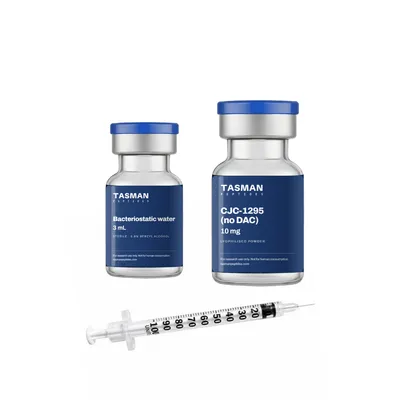
Starter kit
Is CJC-1295 (no DAC) available in Australia?
CJC-1295 without DAC is not registered on the ARTG, and there is no TGA-approved product containing it. Tasman Peptides supplies it as a research chemical for laboratory research only. It is not sold for human consumption. How the TGA treats research peptides →
Side effects reported in studies
There are no published side-effect data for CJC-1295 without DAC in these records; the only human safety data come from trials of CJC-1295 with DAC. Those trials reported no serious adverse reactions and described the DAC compound as relatively well tolerated, particularly at 30 or 60 micrograms/kg. Read more →
Doses used in studies
No study in these records gave CJC-1295 without DAC to people, so there is no published human dose for it here. The human doses reported for CJC-1295 with DAC were ascending single subcutaneous doses, repeated weekly or fortnightly (Teichman et al.), and 60 or 90 micrograms/kg as a single injection (Ionescu et al.). The only no-DAC-family dose in the records is 10 micrograms i.v. of the unmodified parent peptide in rats. Read more →
Reconstitution
| Vial | BAC water (example) | Concentration |
|---|---|---|
| 10 mg | 2 mL | 5 mg/mL |
CJC-1295 (no DAC) FAQ
Where can I buy CJC-1295 without DAC in Australia?
Tasman Peptides supplies research-grade CJC-1295 without DAC (Mod GRF 1-29) in Australia for laboratory research only. It comes as lyophilised powder in a 10 mg vial, each batch is tested by HPLC, and orders are dispatched from Australian stock. It is not sold for human consumption and is not a TGA-approved product.
What is the difference between CJC-1295 with and without DAC?
The difference is one reactive group. CJC-1295 with DAC carries a maleimido lysine at the C-terminus that binds to albumin in the blood, which gave it a half-life of 5.8-8.1 days in human trials. Without DAC the chain is Mod GRF 1-29, which has no albumin binding and is expected to be cleared much faster; the unmodified parent peptide had a half-life of about 10 minutes in rats.
Is CJC-1295 without DAC the same as Mod GRF 1-29?
Yes, CJC-1295 without DAC and Mod GRF 1-29 are two names for the same peptide. It is the first 29 amino acids of human GHRH with four substitutions that make it more resistant to enzyme breakdown. The name CJC-1295 on its own usually refers to the DAC version in the published literature, so check which molecule a study used.
Were the CJC-1295 human trials done with or without DAC?
The published human trials used CJC-1295 with DAC. Teichman et al. (2006) and Ionescu et al. (2006) both describe a long-acting, albumin-binding compound with a half-life of about a week. No study in our records gave the no-DAC compound to people, so their results should not be read as results for Mod GRF 1-29.
What have studies reported about CJC-1295 and ipamorelin together?
None of the studies in our CJC-1295 records tested the pair, so there is no published combined result or dose to report here. The pairing is discussed because the two act on different receptors: CJC-1295 on the GHRH receptor and ipamorelin on the growth hormone secretagogue receptor. Tasman supplies a premixed 10 mg research vial of CJC-1295 no DAC 5 mg with ipamorelin 5 mg.
How much is CJC-1295 without DAC per mg?
CJC-1295 without DAC is sold in one size, a 10 mg vial, and the current price is shown in the size table on this page. Dividing the vial price by 10 gives the price per mg. The starter kit and the CJC-1295 + ipamorelin blend are priced separately.
Is there a CJC-1295 starter kit?
Yes, there is a CJC-1295 starter kit. It is built around the 10 mg vial, and the kit page lists exactly what it includes. Like the vial, it is supplied for laboratory research only.
How should CJC-1295 without DAC be stored?
Store the dry powder at −20 °C, sealed, dry and away from light. Once reconstituted, keep it at 2–8 °C and use it within 28 days, as is generally reported for reconstituted peptides. Avoid repeated freezing and thawing of a mixed solution.
Is CJC-1295 legal in Australia?
CJC-1295, with or without DAC, is not registered on the ARTG and there is no TGA-approved product containing it. Tasman Peptides supplies it as a research chemical for laboratory research only. In sport it is treated as a prohibited substance under section S2 of the WADA Prohibited List.
What is CJC-1295 without DAC studied for?
CJC-1295 without DAC belongs to the GRF(1-29) family, which is studied for how it binds the pituitary GHRH receptor and releases growth hormone. The published work in our records is rat pharmacokinetics of the parent peptide and in-vitro structure-activity studies. The human growth hormone and IGF-I results often quoted come from the DAC version.
Compare with
Related compounds
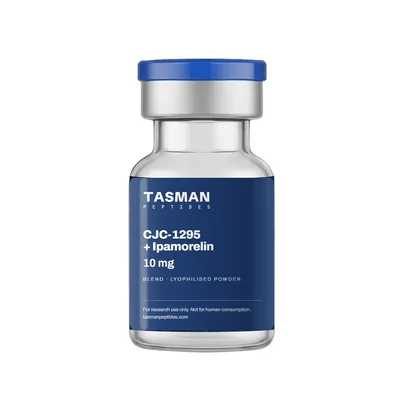
CJC-1295 + Ipamorelin
Two-peptide research blend: a GHRH analogue and a ghrelin receptor (GHS-R) agonist
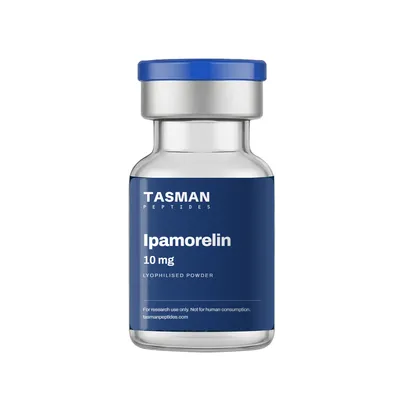
Ipamorelin
Growth hormone secretagogue (ghrelin receptor agonist)
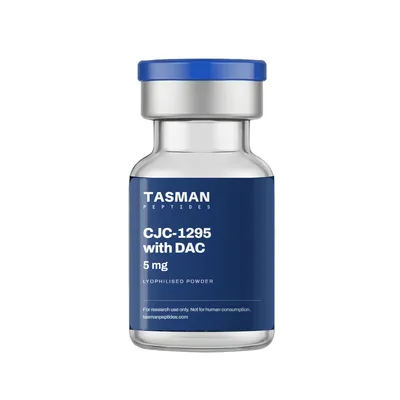
CJC-1295 with DAC
Long-acting growth hormone-releasing hormone (GHRH) analogue