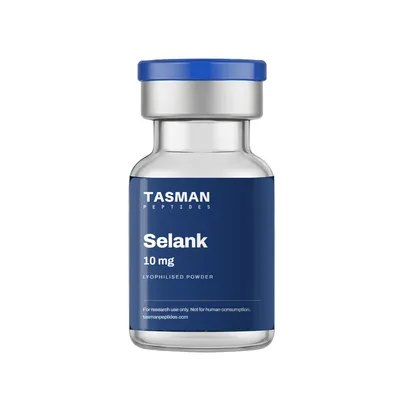

- Also known as
- ACTH(4-7)PGP · ACTH(4-10) analogue · Semax peptide · Met-Glu-His-Phe-Pro-Gly-Pro
- Class
- Synthetic ACTH(4-10) analogue
- Form
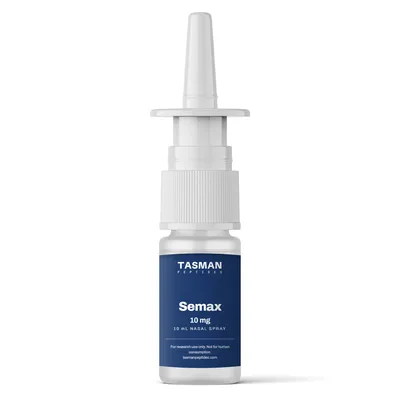
- Lyophilised powder (10 mg vial); nasal spray 10 mg / 10 mL
- Sizes
- 10 mg
- Storage, dry
- −20 °C, dry and dark
- Storage, mixed
- 2–8 °C, use within 28 days of mixing (as generally reported for reconstituted peptides)
- BAC water per size
- 10 mg: 2 mL
What is Semax?
Semax is a synthetic heptapeptide, Met-Glu-His-Phe-Pro-Gly-Pro, made by joining the 4-7 fragment of adrenocorticotropic hormone (ACTH) to a C-terminal Pro-Gly-Pro tripeptide. It is described in the literature as an analogue of ACTH(4-10) that lacks hormonal activity. Most of the work on it comes from Russian groups, where it has been studied in ischaemic stroke and cerebrovascular patients, usually by the intranasal route. Laboratory studies look at how it changes brain-derived neurotrophic factor (BDNF) and nerve growth factor (NGF) gene expression in rats, how it shifts gene expression after experimental cerebral ischaemia, how it binds copper and zinc, and how it inhibits enkephalin-degrading enzymes in human serum. The human data are mostly small, open or controlled Russian clinical studies rather than large randomised trials.
What the research shows
| Study | Model | Dose used | Duration | Finding |
|---|---|---|---|---|
| Gusev EI et al.2018 · Zh Nevrol Psikhiatr Im S S Korsakova · PMID 29798983 | Human, controlled clinical study, ischaemic stroke rehabilitation (n=110) | 6000 mcg/day | Two 10-day courses with a 20-day interval; patients followed for about 5 months | Semax raised plasma BDNF, which stayed high through the study, regardless of when rehabilitation started. Semax and high BDNF were associated with faster improvement and a better final Barthel index score. |
| Gusev EI et al.1997 · Zh Nevrol Psikhiatr Im S S Korsakova · PMID 11517472 | Human, controlled clinical trial, acute hemispheric ischaemic stroke (n=30 Semax, 80 conventional-therapy controls) | 12 mg/day (moderate stroke) and 18 mg/day (severe stroke) were reported as the most effective daily doses | 5- and 10-day courses | Adding Semax to standard intensive therapy had some influence on the rate of recovery of neurological function, particularly motor deficits, assessed with clinical scales, EEG mapping and somatosensory evoked potentials. |
| Lebedeva IS et al.2018 · Bull Exp Biol Med · PMID 30225715 | Human, placebo-controlled resting-state fMRI study in healthy volunteers (n=24: 14 Semax, 10 placebo) | Intranasal 1% Semax (volume not stated in the abstract) | Single administration; scans before and 5 and 20 min after | The Semax group showed a greater volume of the rostral (medial frontal cortex) subcomponent of the default mode network than the placebo group. |
| Ivanikov IO et al.2002 · Bull Exp Biol Med · PMID 12459874 | Human, controlled clinical study, refractory peptic ulcer (n not stated in the abstract) | Intranasal 1% solution, 2–4 drops three times a day, alongside omeprazole, De-Nol and Solcoseryl | 10 days; healing assessed on day 14 | Ulcer healing on day 14 was seen in 89.5% of patients given intranasal Semax versus 30.8% of controls. The authors call for further clinical studies. |
| Gusev EI et al.2005 · Zh Nevrol Psikhiatr Im S S Korsakova · PMID 15792140 | Human, comparative study, cerebrovascular insufficiency (n=187) | Not stated in the abstract | Not stated in the abstract | Semax was associated with clinical improvement, stabilisation of disease progress and a reduced risk of stroke and transient ischaemic attack. The authors report a minor percentage of side effects and good tolerability, including in older patients. |
| Filippenkov IB et al.2020 · Genes (Basel) · PMID 32580520 | Rat, transient middle cerebral artery occlusion (tMCAO) model | Not stated in the abstract | Brain tissue analysed 24 h after tMCAO | RNA-Seq found 394 differentially expressed genes with Semax versus saline. Semax suppressed inflammation-related genes and activated neurotransmission-related genes, the reverse of the pattern seen with ischaemia-reperfusion alone. |
| Shadrina M et al.2010 · J Mol Neurosci · PMID 19662538 | Rat (male Wistar), gene expression in hippocampus, frontal cortex and retina | Not stated in the abstract | Tissue sampled from 20 min to 24 h after administration | NGF and BDNF expression moved in different directions by tissue: both fell in the hippocampus and retina at 20 min and rose in the frontal cortex, and retinal BDNF rose significantly by 90 min. |
| Liu R et al.2025 · Br J Pharmacol · PMID 40692165 | Mouse (female C57BL/6), spinal cord injury at T9-T10; PC12 cell neuroinflammation model | Not stated in the abstract | Not stated in the abstract | Semax improved functional recovery scores and reduced lysosomal membrane permeabilisation-related pyroptosis and oxidative stress. The authors link the effect to the μ-opioid receptor and the deubiquitinase USP18. |
What these studies don't show: The human studies are Russian clinical studies with small or unstated sample sizes, and none of the abstracts here describe a large, blinded, randomised trial. Tolerability is described only in general terms, with no adverse-event rates. The mechanism work is rodent or cell-based, and the rat abstracts do not state the dose or route. There are no long-term human safety data in these records.
Every study links to its PubMed record. See all Semax studies in the research library →
Semax price in Australia: 10mg vial
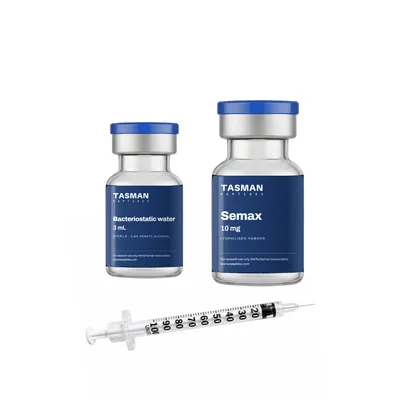
Buy Semax in Australia in a 10mg vial, plus a nasal spray and a starter kit. Prices are in AUD, you pay by PayID or bank transfer, and orders are dispatched from Australian stock.
| Size | Price | Per mg | BAC water (example) |
|---|---|---|---|
| 10 mg | $69.99 | $7.00/mg | 2 mL |
The BAC water column is an example volume for the maths only. Open the calculator (pre-set for Semax).
Other formats and kits
Is Semax available in Australia?
Semax is not registered on the ARTG, and there is no TGA-approved Semax product in Australia. Tasman supplies Semax as a research chemical for laboratory research only, not for human or veterinary use. The published clinical work on Semax comes almost entirely from Russia, which has no bearing on its status here. How the TGA treats research peptides →
Side effects reported in studies
The Semax studies here say little about adverse events: one Russian study of 187 cerebrovascular patients describes a minor percentage of side effects and good tolerability, including in older patients, without giving rates. The measured outcomes are mostly plasma BDNF, stroke recovery scales, ulcer healing and brain imaging, in small Russian clinical studies and in rodents. Read more →
Doses used in studies
The Semax doses in these records come from Russian clinical studies and are reported here only as the doses those studies used: 6000 mcg/day in two 10-day courses in a stroke rehabilitation study, 12–18 mg/day for 5–10 days in acute stroke, and a 1% intranasal solution in an ulcer study and a healthy-volunteer fMRI study. The rodent abstracts do not state the dose. None of this is a dosing recommendation. Read more →
Reconstitution
| Vial | BAC water (example) | Concentration |
|---|---|---|
| 10 mg | 2 mL | 5 mg/mL |
Semax FAQ
Where can I buy Semax in Australia?
Tasman supplies research-grade Semax from Australian stock, as a 10 mg lyophilised vial and as a 10 mg / 10 mL nasal spray. Each batch is tested by HPLC before dispatch. It is sold for laboratory research only, not for human or veterinary use, and Semax is not registered on the ARTG.
How much is Semax per mg?
The size table on this page lists each format with its current price, so the cost per mg can be read straight from it. The 10 mg vial and the 10 mg / 10 mL spray contain the same total amount of peptide; the spray is already in solution, while the vial is dry powder that is reconstituted in the lab.
What is Semax studied for?
Semax has mainly been studied in ischaemic stroke and cerebrovascular insufficiency, in Russian clinical studies measuring recovery scales and plasma BDNF. Other records cover refractory peptic ulcer, glaucomatous optic neuropathy, resting-state brain imaging in healthy volunteers, and rodent work on neurotrophin gene expression, cerebral ischaemia and spinal cord injury.
Is Semax legal in Australia?
Semax is not registered on the ARTG, and there is no TGA-approved Semax product. Tasman supplies it only as a research chemical for laboratory use. Its clinical use in Russia does not create any approval in Australia.
What is the difference between the Semax vial and the nasal spray?
The vial holds 10 mg of freeze-dried Semax that must be reconstituted before use in the lab, and it keeps longest stored dry. The spray holds 10 mg already dissolved in 10 mL, which is 1 mg per mL (0.1%). The intranasal studies in the record used a 1% solution, which is ten times more concentrated.
How should Semax be stored?
Store the dry powder at −20 °C, sealed, dry and away from light. Once reconstituted, keep it at 2–8 °C and use it within 28 days, as is generally reported for reconstituted peptides. Keep the nasal spray refrigerated at 2–8 °C and out of direct light.
Semax vs Selank: what is the difference?
Semax and Selank are both synthetic heptapeptides ending in Pro-Gly-Pro, but they come from different parent molecules. Semax is built on an ACTH fragment and is described as a nootropic, while Selank is built on tuftsin and is described as an anxiolytic. A 2020 fMRI study in 52 healthy people found both general and specific effects of each on amygdala connectivity.
Does Semax increase BDNF?
In a Russian study of 110 stroke patients, Semax raised plasma BDNF, and levels stayed high through the study. In rats, the picture was mixed: BDNF and NGF gene expression fell in the hippocampus and retina 20 minutes after Semax and rose in the frontal cortex, with retinal BDNF rising by 90 minutes.
Is Semax the same as N-acetyl Semax?
No. N-acetyl Semax has an acetyl group on its N-terminus, and a 2016 study found this changes how it binds copper(II). In that study the acetylated form did not protect SH-SY5Y neuroblastoma cells from copper toxicity, which the authors attributed to the loss of the free N-terminal amino group. Tasman's Semax is the standard, non-acetylated peptide.
Is there a Semax starter kit?
Yes. The Semax 10 mg vial is also offered as a starter kit, and the product page lists exactly what the kit includes. Like the vial on its own, the kit is supplied for laboratory research only.