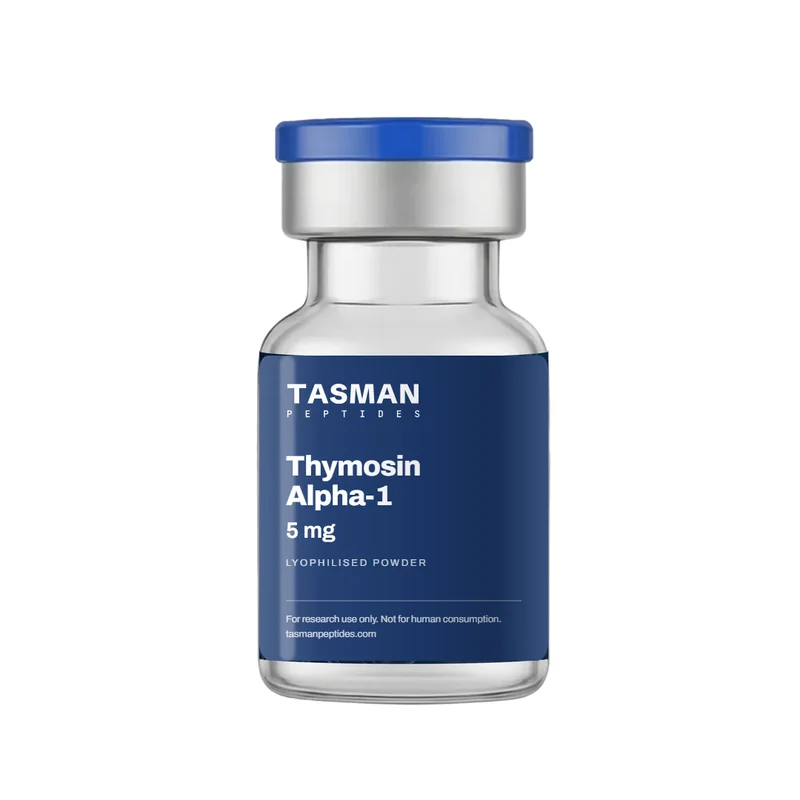
- Also known as
- Thymalfasin · Tα1 · Ta1 · Thymosin α1 · TA-1 · Zadaxin
- Class
- Thymic peptide, immunomodulator
- Form
- Lyophilised powder
- Sizes
- 5 mg · 10 mg
- Storage, dry
- −20 °C, dry and dark
- Storage, mixed
- 2–8 °C, use within 28 days of mixing (as generally reported for reconstituted peptides)
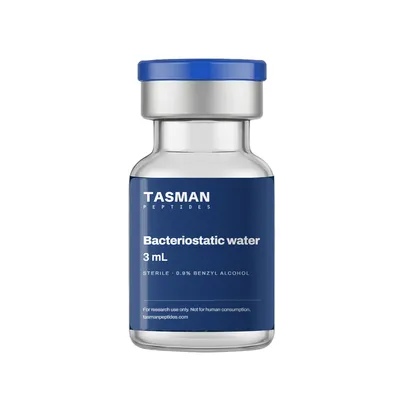
- BAC water per size
- 5 mg: 2 mL · 10 mg: 2 mL
What is Thymosin Alpha-1?
Thymosin alpha-1 is a peptide originally isolated from thymic tissue as the compound responsible for restoring immune function in thymectomised mice. The synthetic version is called thymalfasin, and it has been marketed as a medicine in some countries under the name Zadaxin. In the reviewed literature it is described as an immune modulator: it acts through Toll-like receptors on dendritic cells, which starts cytokine signalling and affects several immune cell subsets involved in immune suppression. Most of the published work is human clinical research, which is unusual for a research peptide. Trials have tested it in chronic hepatitis B and C, sepsis and metastatic melanoma, usually alongside standard treatment. The larger and more recent trials give a mixed picture, and the largest, a 1106-patient sepsis trial, found no mortality benefit.
What the research shows
| Study | Model | Dose used | Duration | Finding |
|---|---|---|---|---|
| Wu J et al.2025 · BMJ · PMID 39814420 | Human, multicentre double-blind randomised placebo-controlled phase 3 trial, adults with sepsis (n=1106 randomised; 1089 analysed) | Not stated in the abstract (subcutaneous injection) | Every 12 hours for seven days | 28-day all-cause mortality was 23.4% with thymosin α1 and 24.1% with placebo (hazard ratio 0.99, P=0.93). No secondary or safety outcome differed significantly; subgroup analyses suggested a possible difference by age and diabetes status. |
| Wu X et al.2018 · Expert Opin Biol Ther · PMID 30063860 | Human, multicentre randomised open-label trial, HBV-related compensated cirrhosis (n=690) | Not stated in the abstract (added to entecavir) | 52 weeks, after 26 weeks of entecavir; median follow-up 38.2 months | Cumulative incidence of liver decompensation, liver cancer (HCC) or death was similar between groups. HCC incidence during combination treatment was 1.7% versus 2.1% with entecavir alone; both therapies were well tolerated. |
| Maio M et al.2010 · J Clin Oncol · PMID 20194853 | Human, randomised trial with five arms, metastatic melanoma (n=488) | 1.6, 3.2 or 6.4 mg, combined with dacarbazine with or without interferon alfa | Primary end point at 12 months; observed for up to 24 months | The 3.2 mg arms had 10 and 12 tumour responses versus four in the control group. Median overall survival was 9.4 versus 6.6 months (hazard ratio 0.80, P=.08), and adding Tα1 did not add toxicity. |
| You J et al.2006 · World J Gastroenterol · PMID 17075991 | Human, randomised controlled trial versus interferon alpha, with a historical control group, HBeAg-positive chronic hepatitis B (n=62; 30 historical controls) | 1.6 mg subcutaneously | Twice a week for six months, then six months of follow-up | Complete response at the end of follow-up was 48.3% (14 of 29) with Tα1 versus 27.3% with interferon alpha, a difference that was not statistically significant (P>0.05); against historical controls it was significantly higher. No side effects appeared in the Tα1 group. |
| Saruc M et al.2003 · J Pharm Sci · PMID 12820143 | Human, non-randomised comparative study, HBeAg-negative chronic hepatitis B (n=52; 27 in the Tα1 group) | 1.6 mg subcutaneously, twice a week, combined with interferon alpha-2b | 26 weeks of combination, then 26 weeks of interferon alone; follow-up to 18 months after treatment | Sustained response was 74% in the Tα1 plus interferon group versus 40% and 53.3% in the comparison groups (p = 0.13). At 18 months after treatment, 71.4% of the Tα1 group kept their response versus 10% and 20% (p = 0.0003). |
What these studies don't show: Most of these trials tested thymosin alpha-1 on top of another treatment (interferon, entecavir or chemotherapy), so its effect on its own is hard to separate. The largest and most recent trial, in sepsis, found no mortality benefit, and the hepatitis studies were small, open-label or non-randomised. None of these studies looked at healthy people, ageing or general immune support, and the abstracts give little detail on individual adverse events.
Every study links to its PubMed record. See all Thymosin Alpha-1 studies in the research library →
Thymosin Alpha-1 price in Australia: 5mg and 10mg vials
Buy Thymosin Alpha-1 in Australia in 2 vial sizes and a starter kit. Prices are in AUD, you pay by PayID or bank transfer, and orders are dispatched from Australian stock.
| Size | Price | Per mg | BAC water (example) |
|---|---|---|---|
| 5 mg | $179.99 | $36.00/mg | 2 mL |
| 10 mg | $289.99 | $29.00/mg | 2 mL |
The BAC water column is an example volume for the maths only. Open the calculator (pre-set for Thymosin Alpha-1).
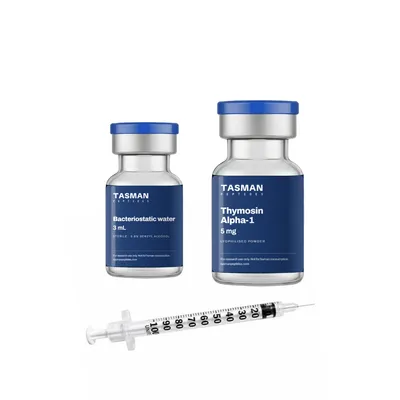
Starter kit
Is Thymosin Alpha-1 available in Australia?
Thymosin alpha-1 is not registered on the ARTG, and there is no TGA-approved product containing it. Tasman Peptides supplies it as a research chemical for laboratory research only. It is not sold for human consumption. How the TGA treats research peptides →
Side effects reported in studies
The human trials cited here reported thymosin alpha-1 as well tolerated: in the 1106-patient sepsis trial no safety outcome differed significantly from placebo, and in the melanoma trial it added no toxicity to chemotherapy. The abstracts do not list individual adverse events or their rates.
Doses used in studies
The dose most often reported in these studies is 1.6 mg given subcutaneously twice a week, used in two chronic hepatitis B studies for six months. A melanoma trial compared 1.6, 3.2 and 6.4 mg alongside chemotherapy, and the largest sepsis trial gave thymosin α1 every 12 hours for seven days without stating the amount in its abstract. These are the doses used in those studies, reported for reference only. Read more →
Reconstitution
| Vial | BAC water (example) | Concentration |
|---|---|---|
| 5 mg | 2 mL | 2.50 mg/mL |
| 10 mg | 2 mL | 5 mg/mL |
Thymosin Alpha-1 FAQ
Where can I buy thymosin alpha-1 in Australia?
Tasman Peptides supplies research-grade thymosin alpha-1 in Australia for laboratory research only. It comes as lyophilised powder in 5 mg and 10 mg vials, each batch is tested by HPLC, and orders are dispatched from Australian stock. It is not sold for human consumption and is not a TGA-approved product.
What is thymosin alpha-1 studied for?
Thymosin alpha-1 has mostly been studied as an add-on to standard treatment in immune-related disease. Human trials in our records cover chronic hepatitis B, HBV-related cirrhosis, hepatitis C, sepsis and metastatic melanoma. Results are mixed: some hepatitis studies reported higher response rates, while the largest trial, in 1106 adults with sepsis, found no difference in 28-day mortality.
What thymosin alpha 1 dosage have studies used?
The dose used most often in the cited studies is 1.6 mg subcutaneously twice a week, reported in two chronic hepatitis B studies (You et al. 2006; Saruc et al. 2003). A melanoma trial compared 1.6, 3.2 and 6.4 mg alongside chemotherapy. These are study doses reported for reference; the dosage page lists each one with its source.
Is thymosin alpha-1 the same as thymalfasin?
Yes, thymalfasin is the name for synthetic thymosin alpha-1. It is the same 28-amino-acid peptide with an acetylated N-terminus that was first isolated from thymus tissue. In some countries it has been marketed as a medicine under the name Zadaxin, which is not registered in Australia.
What is the difference between thymosin alpha-1 and TB-500?
They are different peptides that share only part of a name. Thymosin alpha-1 is a 28-amino-acid thymic peptide studied as an immune modulator in hepatitis, sepsis and cancer trials. TB-500 is a synthetic peptide based on thymosin beta-4, a separate protein, and its literature is mostly animal work on tissue repair. Each has its own page with its own studies.
Is thymosin alpha-1 legal in Australia?
Thymosin alpha-1 is not registered on the ARTG, and there is no TGA-approved product containing it. Tasman Peptides supplies it as a research chemical for laboratory use only. Its registration as a medicine in some other countries does not change its status here.
How much is thymosin alpha-1 per mg?
Thymosin alpha-1 comes in 5 mg and 10 mg vials, and the current prices are shown in the size table on this page. Dividing each vial price by its size gives the price per mg, so the two sizes can be compared directly. The starter kit is priced separately.
Which thymosin alpha-1 vial size should I choose, 5 mg or 10 mg?
The two vials contain the same peptide at the same tested purity; only the amount differs. A 5 mg vial suits smaller or shorter experiments, and a 10 mg vial suits longer runs. Once mixed, a vial should be used within about 28 days, so the size is best matched to how much a protocol will use in that time.
Is there a thymosin alpha-1 starter kit?
Yes, there is a thymosin alpha-1 starter kit. It is built around the research vial, and the kit page lists exactly what it includes. Like the vial, it is supplied for laboratory research only.
How should thymosin alpha-1 be stored?
Store the dry powder at −20 °C, sealed, dry and away from light. Once reconstituted, keep it at 2–8 °C and use it within 28 days, as is generally reported for reconstituted peptides. Avoid repeated freezing and thawing of a mixed solution.