
Which format?
| Capsules | Vial | |
|---|---|---|
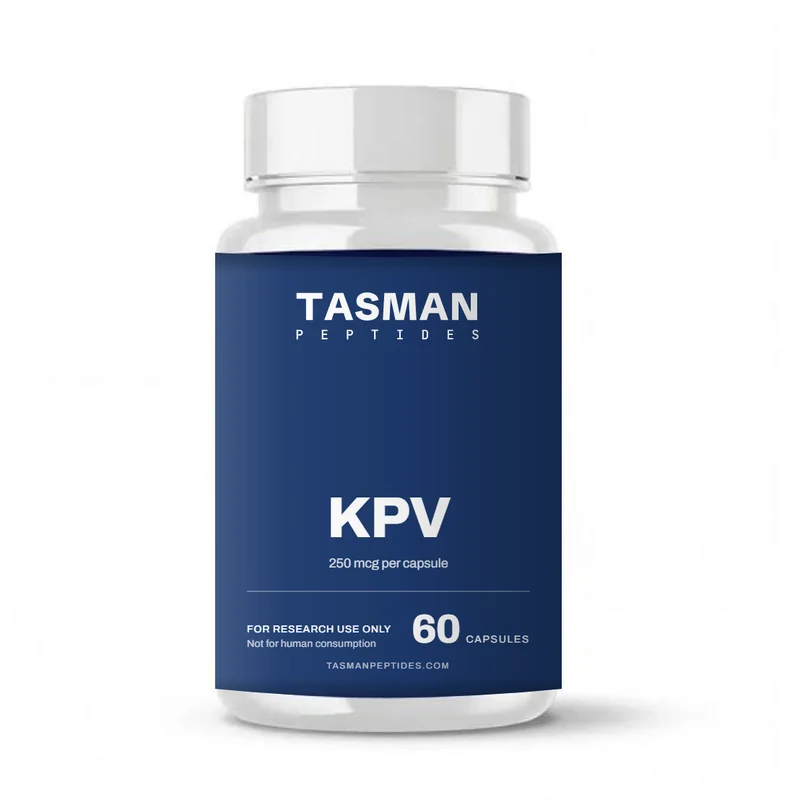
| Strength per capsule | 250 mcg KPV | — |
| How supplied | Bottle of 60 capsules (15 mg KPV in total) | — |
| Needs mixing? | No. The 10 mg vial is lyophilised powder that is reconstituted before use in the lab; capsules are ready as supplied. | Yes, with BAC water |
| Storage | Keep the bottle sealed, cool, dry and away from light | −20 °C dry; 2–8 °C mixed |
Storage and handling
Keep KPV capsules in the sealed bottle in a cool, dry place away from light, and close the lid after opening. Moisture is the main thing to keep out. Follow any storage line printed on the bottle label.
Studies that used the oral route
| Study | Model | Dose used | Duration | Finding |
|---|---|---|---|---|
| Dalmasso G et al.2008 · Gastroenterology · PMID 18061177 | Mouse, DSS- and TNBS-induced colitis models; human intestinal and immune cells | KPV added to drinking water; amount not stated in the abstract | Not stated in the abstract | Oral administration of KPV reduced the incidence of DSS- and TNBS-induced colitis, with lower pro-inflammatory cytokine expression. KPV entered cells through PepT1, a transporter induced in the colon during inflammatory bowel disease. |
| Xiao B et al.2017 · Mol Ther · PMID 28143741 | Mouse, ulcerative colitis model | Oral HA-KPV nanoparticles in a chitosan/alginate hydrogel; amount not stated in the abstract | Not stated in the abstract | Oral HA-KPV nanoparticles in hydrogel released the nanoparticles in the colon, prevented mucosal damage and lowered TNF-α more than a KPV nanoparticle hydrogel without hyaluronic acid. |
Capsules FAQ
Has oral KPV been studied?
Yes, in mice. A 2008 study added KPV to drinking water and found reduced DSS- and TNBS-induced colitis, and a 2017 study gave KPV orally in nanoparticles within a hydrogel. Both are mouse studies, and the abstracts do not state the amounts used. There are no human oral KPV data in our records.
How much KPV is in each capsule?
Each capsule contains 250 mcg of KPV, and each bottle holds 60 capsules, or 15 mg in total. The capsule strength is a fixed product specification. It is not a dose from any study, and the studies on this page did not report their amounts.
KPV capsules or vial: what is the difference?
The vial holds 10 mg of lyophilised powder that is reconstituted with a diluent in the lab, so the concentration can be set by volume. Capsules are pre-measured at 250 mcg and need no mixing. Both are the same tripeptide and both are supplied for laboratory research only.
How should KPV capsules be stored?
Keep the capsules in their sealed bottle, somewhere cool, dry and dark, and close the lid after each opening. Keeping moisture out matters most for a dry capsule product. Follow any storage line on the bottle label, and keep the bottle out of direct sunlight and away from heat sources such as ovens or car dashboards.
Why do KPV studies use nanoparticles and hydrogels?
Because free KPV breaks down easily. One rat study notes that plain KPV solution is very unstable when given rectally, and others carried KPV in nanoparticles or hydrogels to protect it and hold it at the inflamed colon lining. Results from those systems are results for the formulation, not for plain KPV.