
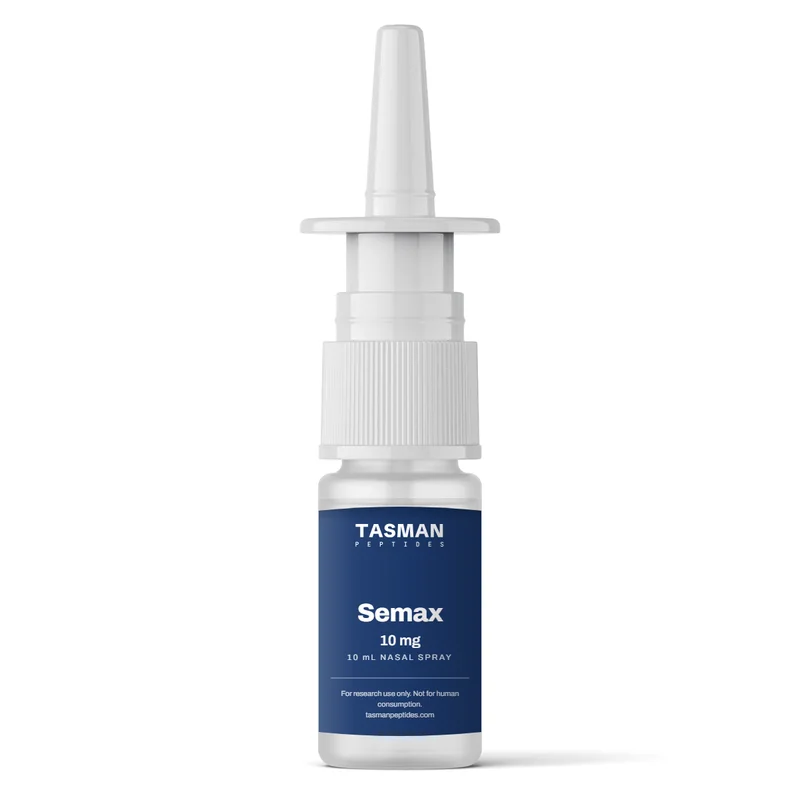
Which format?
| Nasal spray | Vial | |
|---|---|---|
| Strength per spray | 1 mg per mL (0.1%); the amount per actuation depends on the pump's spray volume, shown on the product label | — |
| How supplied | 10 mg Semax in 10 mL solution, in a nasal spray bottle | — |
| Needs mixing? | No. It is supplied as a ready-made solution | Yes, with BAC water |
| Storage | 2–8 °C, capped and away from light | −20 °C dry; 2–8 °C mixed |
Storage and handling
Keep the spray refrigerated at 2–8 °C with the cap on and out of direct light. Peptides in solution break down faster than dry powder, so the 10 mg lyophilised vial stored at −20 °C is the better choice where long storage is needed.
Studies that used the intranasal route
| Study | Model | Dose used | Duration | Finding |
|---|---|---|---|---|
| Lebedeva IS et al.2018 · Bull Exp Biol Med · PMID 30225715 | Human, placebo-controlled resting-state fMRI study in healthy volunteers (n=24: 14 Semax, 10 placebo) | Intranasal 1% Semax (volume not stated in the abstract) | Single administration; scans before and 5 and 20 min after | The Semax group showed a greater volume of the rostral (medial frontal cortex) subcomponent of the default mode network than the placebo group. |
| Ivanikov IO et al.2002 · Bull Exp Biol Med · PMID 12459874 | Human, controlled clinical study, refractory peptic ulcer (n not stated in the abstract) | Intranasal 1% solution, 2–4 drops three times a day, alongside standard ulcer drugs | 10 days; healing assessed on day 14 | Ulcer healing on day 14 was seen in 89.5% of patients given intranasal Semax versus 30.8% of controls. |
| Tsai SJ2007 · Med Hypotheses · PMID 16996699 | Hypothesis paper (no new data) | Not stated in the abstract | Not stated in the abstract | Summarises earlier reports that intranasal Semax stimulated memory and attention in rodents and humans, and proposes it for study in ADHD and Rett syndrome on the basis of dopamine and BDNF effects. |
Nasal spray FAQ
What concentration is Semax nasal spray?
Tasman's Semax nasal spray is 0.1%: 10 mg of Semax in 10 mL, or 1 mg per mL. The Russian intranasal studies in the research record used a 1% solution, which is 10 mg per mL, so this spray is one-tenth of the concentration those studies describe.
Has Semax been studied as a nasal spray?
Yes. Intranasal Semax was used in a healthy-volunteer fMRI study (1% solution, 14 people given Semax and 10 placebo) and in a refractory peptic ulcer study (1% solution as drops, three times a day for 10 days). Those studies used drops or an unspecified intranasal dose, not this specific spray.
Does Semax nasal spray need to be mixed?
No. The spray is supplied as a ready-made solution, so no bacteriostatic water or reconstitution is needed. The 10 mg vial is the format that needs reconstituting.
How long does Semax nasal spray keep?
Keep it at 2–8 °C, capped and out of light. Peptides in solution are less stable than dry powder, so for longer storage the lyophilised vial kept at −20 °C holds up better.
The full Semax rundown
Research, vial sizes, storage and FAQs are on the main Semax page.
View Semax →