
- Also known as
- AOD9604 · AOD 9604 · Tyr-hGH 177-191 · hGH fragment 176-191
- Class
- Modified hGH C-terminal fragment (177–191 plus N-terminal tyrosine)
- Form
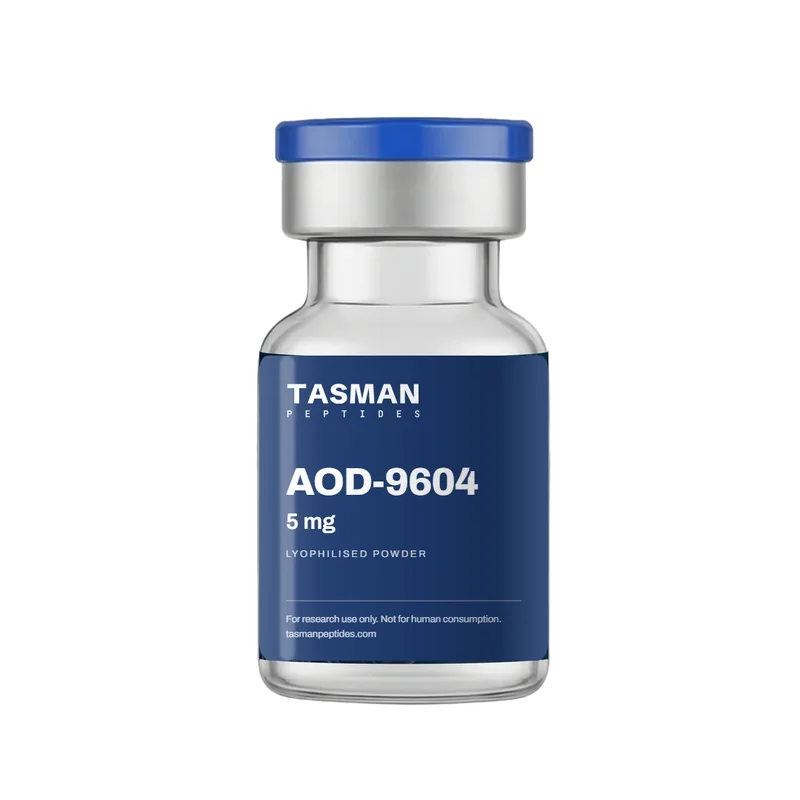
- Lyophilised powder, 5 mg vial
- Sizes
- 5 mg
- Storage, dry
- −20 °C, dry and dark
- Storage, mixed
- 2–8 °C, use within 28 days of mixing (as generally reported for reconstituted peptides)
- BAC water per size
- 5 mg: 2 mL
What is AOD-9604?
AOD-9604 is a synthetic peptide made from the C-terminal end of human growth hormone: amino acids 177–191 with an extra tyrosine added at the N-terminus. It was designed to keep the part of growth hormone linked to fat metabolism without the rest of the molecule. The earlier work, on the unmodified 177–191 fragment, found it reduced fat formation (lipogenesis) in rat and mouse fat tissue. Later studies of AOD-9604 itself reported lower body weight gain and higher lipolytic activity in obese rodents, and one study found no loss of insulin sensitivity in rats, which intact growth hormone did affect. Obesity trials in people were underway by 2002. The peptide is on the World Anti-Doping Agency's banned list, and an anti-doping test for it in urine has been published.
What the research shows
| Study | Model | Dose used | Duration | Finding |
|---|---|---|---|---|
| Ng FM et al.2000 · Horm Res · PMID 11146367 | Rat, obese Zucker rats | 500 µg/kg body weight, oral, daily | 19 days | Body weight gain was less than half that of controls (15.8 ± 0.6 vs 35.6 ± 0.8 g) and adipose tissue showed higher lipolytic activity. Unlike chronic intact hGH, AOD9604 had no adverse effect on insulin sensitivity by euglycaemic clamp. |
| Heffernan M et al.2001 · Endocrinology · PMID 11713213 | Mouse, obese mice and beta3-adrenergic receptor knock-out mice | Not stated in the abstract (intraperitoneal) | 14 days chronic, plus an acute experiment | hGH and AOD9604 reduced body weight and body fat in obese mice and raised beta3-AR RNA to lean-mouse levels. In knock-out mice the chronic weight and lipolysis effects were absent, though AOD9604 still raised energy expenditure and fat oxidation acutely. |
| Kwon DR et al.2015 · Ann Clin Lab Sci · PMID 26275694 | Rabbit, collagenase-induced knee osteoarthritis model (n=32) | 0.25 mg AOD9604 intra-articular, with or without 6 mg hyaluronic acid, weekly | Weeks 4–7 after the first collagenase injection; assessed at 8 weeks | Cartilage morphology and histopathology scores were better in all treated groups than saline, and best with AOD9604 plus hyaluronic acid, which also gave the shortest lameness period. |
| Natera SH et al.1994 · Biochem Mol Biol Int · PMID 7987248 | Mouse, ob/ob (C57BL/6J) mice; unmodified hGH 177-191 peptide | Not stated in the abstract | Not stated in the abstract (described as long-term) | hGH 177-191 reduced cumulative body weight gain and adipose tissue mass, and significantly inhibited lipogenesis in adipose tissue. |
| Wu Z et al.1993 · Biochem Mol Biol Int · PMID 8358331 | Rat, adipose tissue and in vitro; unmodified hGH 177-191 peptide | Not stated in the abstract | Not stated in the abstract | hGH 177-191 had antilipogenic activity identical to intact hGH, with no significant lipolytic effect measured as glycerol release from epididymal fat pads. |
| Cox HD et al.2015 · Drug Test Anal · PMID 25208511 | In vitro (incubation in human serum and urine); analytical method validation | Not applicable | Not applicable | A urine extraction method detected AOD9604 down to 50 pg/mL. Six metabolites were identified, and one (CRSVEGSCG) was significantly more stable in serum than the parent peptide. |
What these studies don't show: Every result in this table comes from rodents, rabbits or lab assays. None of these records reports human trial outcomes, so they say nothing about effects, safety or dose in people. Two of the six studies used the unmodified 177–191 fragment rather than AOD-9604 itself, and several abstracts do not give the dose or the number of animals.
Every study links to its PubMed record. See all AOD-9604 studies in the research library →
AOD-9604 price in Australia: 5mg vial
Buy AOD-9604 in Australia in a 5mg vial and a starter kit. Prices are in AUD, you pay by PayID or bank transfer, and orders are dispatched from Australian stock.
| Size | Price | Per mg | BAC water (example) |
|---|---|---|---|
| 5 mg | $99.99 | $20.00/mg | 2 mL |
The BAC water column is an example volume for the maths only. Open the calculator (pre-set for AOD-9604).
Starter kit
Is AOD-9604 available in Australia?
AOD-9604 is not registered on the ARTG, and there is no TGA-approved product containing it. Tasman Peptides supplies it as a research chemical for laboratory use only, not as a medicine or supplement. It is also on the World Anti-Doping Agency's prohibited list, which matters for anyone subject to sport testing. How the TGA treats research peptides →
Side effects reported in studies
The AOD-9604 abstracts on file report no adverse events, and none of them describe a human trial. The measured results are animal outcomes: lower weight gain and body fat in obese rodents, unchanged insulin sensitivity in rats, and better cartilage scores in a rabbit knee model. Read more →
Doses used in studies
The doses on record are animal doses: 500 µg/kg by mouth daily for 19 days in obese rats, and 0.25 mg by weekly intra-articular injection in rabbits. The mouse studies used intraperitoneal dosing for 14 days but the abstract does not give the amount. These figures describe the study designs only. Read more →
Reconstitution
| Vial | BAC water (example) | Concentration |
|---|---|---|
| 5 mg | 2 mL | 2.50 mg/mL |
AOD-9604 FAQ
Where can I buy AOD-9604 in Australia?
Tasman Peptides supplies research-grade AOD-9604 in 5 mg vials, dispatched from Australian stock. It is sold for laboratory research only, not as a medicine or for human use. It is tested by HPLC, and the purity result is shown on the product page.
How much is AOD-9604 per mg?
The cost per mg is shown in the size table on this page. AOD-9604 comes in a single 5 mg vial, and the table lists the price of the vial and of the starter kit so you can work out the per-mg figure directly.
What is AOD-9604 studied for?
AOD-9604 has mainly been studied for fat metabolism in obese rodents. Rat and mouse studies measured body weight gain, body fat, lipolysis and insulin sensitivity. One rabbit study looked at cartilage in a knee osteoarthritis model, and an anti-doping lab published a detection method. None of the records on file report human outcomes.
Is AOD-9604 legal in Australia?
AOD-9604 is not registered on the ARTG, and there is no TGA-approved product containing it. Tasman supplies it only as a research chemical for laboratory work. It is also prohibited in sport by the World Anti-Doping Agency, and a urine test for it has been published.
What is the difference between AOD-9604 and hGH fragment 176-191?
The names usually refer to the same peptide. AOD-9604 is hGH amino acids 177–191 with a tyrosine added at the N-terminus, which is why it is often labelled fragment 176-191. The older studies used the unmodified 177–191 fragment without the extra tyrosine. That is a closely related but separate peptide.
Does AOD-9604 affect insulin sensitivity?
In obese Zucker rats given 500 µg/kg orally each day for 19 days, AOD9604 had no adverse effect on insulin sensitivity measured by euglycaemic clamp. Chronic treatment with intact growth hormone did affect it in the same study. This is a single rat study, and there are no human data on file.
How should AOD-9604 be stored?
Store the dry powder at −20 °C, sealed and away from light. Once reconstituted, keep it at 2–8 °C and use it within about 28 days, which is the figure generally reported for reconstituted peptides. Avoid repeated freezing and thawing of mixed solution.
How much bacteriostatic water for a 5 mg AOD-9604 vial?
The size table uses 2 mL for the 5 mg vial as a neutral default, based on 1 mL per 5 mg with a 2 mL minimum. This is arithmetic for working out concentration, not a dosing guide. The site calculator converts any volume you choose into mg per mL.
What comes in the AOD-9604 starter kit?
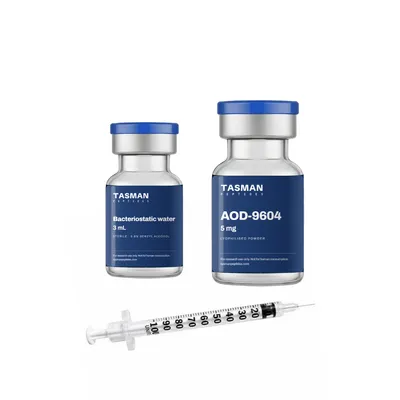
The AOD-9604 starter kit contains one 5 mg vial, 3 mL of bacteriostatic water, ten 0.5 mL insulin syringes and 20 alcohol swabs. It groups the reconstitution supplies for a lab bench in one order. The vial is the same product sold on its own.
AOD-9604 vs 5-Amino-1MQ: what is the difference?
They are different kinds of compound. AOD-9604 is a peptide fragment of human growth hormone studied for lipolysis and lipogenesis in obese rodents. 5-Amino-1MQ is a small molecule, not a peptide, that works on a different target. See the comparison page for the studies behind each.
Compare with
Related compounds
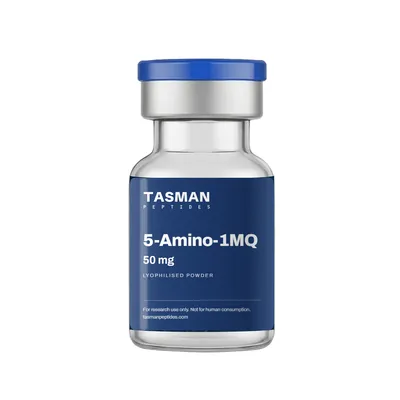
5-Amino-1MQ
Small-molecule nicotinamide N-methyltransferase (NNMT) inhibitor
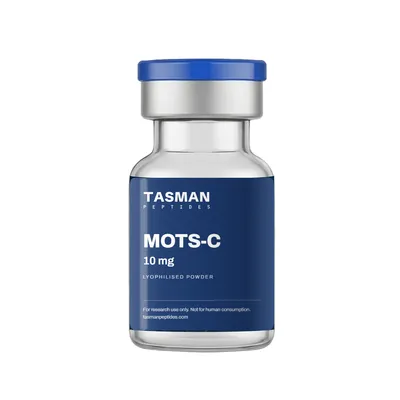
MOTS-C
Mitochondrial-derived peptide
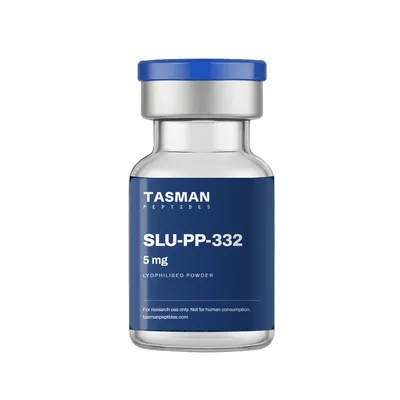
SLU-PP-332
Synthetic pan-ERR (ERRα/β/γ) agonist, small molecule
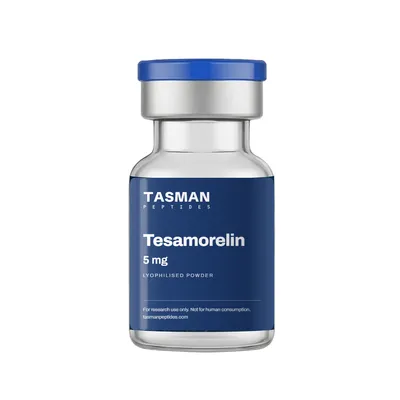
Tesamorelin
Growth hormone-releasing hormone (GHRH) analogue