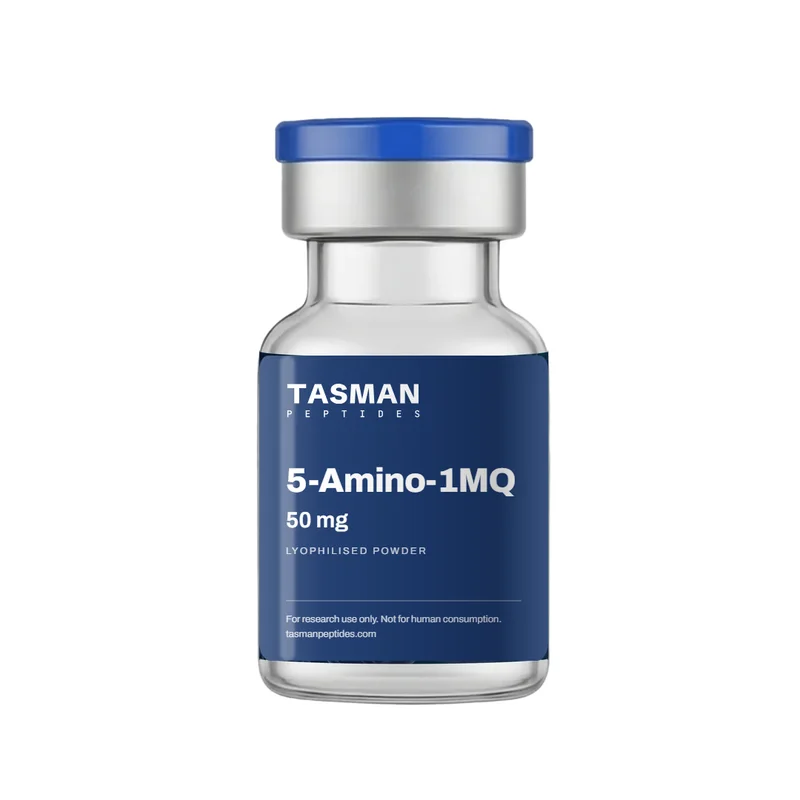
- Also known as
- 5-amino-1-methylquinolinium · 5A1MQ · 5-AMQ · 5MQ · NNMT inhibitor
- Class
- Small-molecule NNMT inhibitor (methylquinolinium)
- Form
- Lyophilised powder, 50 mg vial
- Sizes
- 50 mg
- Storage, dry
- −20 °C, dry and dark
- Storage, mixed
- 2–8 °C, use within 28 days of mixing (as generally reported for reconstituted peptides)
- BAC water per size
- 50 mg: 5 mL
What is 5-Amino-1MQ?
5-Amino-1MQ (5-amino-1-methylquinolinium) is a small molecule, not a peptide, that blocks the enzyme nicotinamide N-methyltransferase (NNMT). NNMT uses the methyl donor S-adenosylmethionine (SAM) to methylate nicotinamide, a vitamin B3 form that cells also recycle into NAD+. That links the enzyme to both NAD+ levels and a cell's methylation balance. NNMT is found at high levels in adipose tissue, where its expression has been linked to obesity and insulin resistance, and it rises in ageing muscle and several cancers. In cultured fat cells, methylquinolinium NNMT inhibitors lowered the reaction product 1-methylnicotinamide, raised NAD+ and SAM and suppressed fat formation. In diet-induced obese mice, 5-Amino-1MQ limited weight and fat gain. All of the evidence is preclinical: no human trial appears in the records on file.
What the research shows
| Study | Model | Dose used | Duration | Finding |
|---|---|---|---|---|
| Babula JJ et al.2024 · Diabetes Obes Metab · PMID 39161060 | Mouse, diet-induced obese (DIO) mice; plus pharmacokinetics in age- and strain-matched mice | Not stated in the abstract (once daily); PK after intravenous, oral and subcutaneous dosing | 28 days | 5A1MQ dose-dependently limited body weight and fat mass gains, improved oral glucose tolerance and insulin sensitivity, and reduced hepatic steatosis and liver triglycerides. ALT, AST and ketone bodies were normalised, and subcutaneous dosing distributed it to adipose, muscle and liver. |
| Neelakantan H et al.2018 · Biochem Pharmacol · PMID 29155147 | Cell culture (adipocytes, Caco-2 permeability) and mouse, diet-induced obese mice; methylquinolinium NNMT inhibitor series (the abstract does not name the compound used in mice) | Not stated in the abstract | Not stated in the abstract | The inhibitors reduced 1-MNA, raised NAD+ and SAM and suppressed lipogenesis in adipocytes. In obese mice, a potent inhibitor reduced body weight, white fat mass, adipocyte size and plasma cholesterol without changing food intake or producing observable adverse effects. |
| Neelakantan H et al.2019 · Biochem Pharmacol · PMID 30753815 | Mouse, 24-month-old mice with barium chloride tibialis anterior injury, plus C2C12 myoblasts; NNMT inhibitor from the same group (the abstract does not name the compound) | 5 or 10 mg/kg NNMTi, or saline control | 1 week or 3 weeks after injury | Muscle stem cell proliferation and fusion increased, myofiber cross-sectional area was nearly 2-fold greater and peak torque of the injured muscle was about 70% higher than in controls. |
| Dimet-Wiley A et al.2022 · Sci Rep · PMID 35013352 | Mouse, diet-induced obese mice switched to a low-fat diet | Not stated in the abstract (5-amino-1-methylquinolinium with low-fat diet) | Not stated in the abstract | Mice given 5-amino-1MQ plus the low-fat diet had a distinct caecal microbiome, with less Erysipelatoclostridium and more Lactobacillus than vehicle-treated mice on the same diet. The abstract notes the combination normalised adiposity and weight to those of lean mice. |
| Yang M et al.2024 · J Immunother Cancer · PMID 39067875 | Mouse, urothelial bladder cancer models; plus human bladder cancer tissue cohorts (association data) | Not stated in the abstract (5-amino-1-methylquinolinium iodide) | Not stated in the abstract | Targeting NNMT with 5-amino-1-methylquinolinium iodide reduced tumour growth and enhanced the apoptotic effects of an anti-PD-L1 antibody in mouse models. The human data were associations between NNMT in tumour fibroblasts and non-response to immunotherapy. |
| Awosemo O et al.2021 · J Pharm Biomed Anal · PMID 34304009 | Rat, pharmacokinetic study with a validated LC-MS/MS assay | Not stated in the abstract (intravenous and oral) | Not stated in the abstract | 5-AMQ reached substantial plasma exposure by both routes, with a mean maximum plasma concentration of 2252 ng/mL after oral dosing. The first terminal half-life reported was 3.80 ± 1.10 h; the stored abstract is cut off before the second value. |
| Akar S et al.2021 · J Obstet Gynaecol · PMID 33645410 | Cell culture (HeLa cervical cancer cells, HEK-293 cells) | 0.1–500 µM 5MQ (5-amino-1-methylquinolinium) | Not stated in the abstract | 5MQ inhibited HeLa cell proliferation in a concentration- and time-dependent manner, with signs of apoptosis and lower phospho-Akt and SIRT1 protein. HEK-293 cell proliferation was not apparently affected. |
What these studies don't show: Every result here comes from mice, rats or cultured cells; there are no human trials of 5-Amino-1MQ in the records on file. Several key abstracts do not state the dose, route or duration, and two of the mouse studies do not name the exact inhibitor used. A 2026 review notes that unknown safety profiles and limited bioavailability have held back NNMT inhibitors as a class.
Every study links to its PubMed record. See all 5-Amino-1MQ studies in the research library →
5-Amino-1MQ price in Australia: 50mg vial
Buy 5-Amino-1MQ in Australia in a 50mg vial and a starter kit. Prices are in AUD, you pay by PayID or bank transfer, and orders are dispatched from Australian stock.
| Size | Price | Per mg | BAC water (example) |
|---|---|---|---|
| 50 mg | $109.99 | $2.20/mg | 5 mL |
The BAC water column is an example volume for the maths only. Open the calculator (pre-set for 5-Amino-1MQ).
Starter kit
Is 5-Amino-1MQ available in Australia?
5-Amino-1MQ is not registered on the ARTG, and there is no TGA-approved product containing it. It has only been studied in animals and cell culture, according to the records on file. Tasman Peptides supplies it as a research chemical for laboratory use only, not as a medicine or supplement. How the TGA treats research peptides →
Side effects reported in studies
No human side-effect data exist for 5-Amino-1MQ in the records on file; the one safety observation is that NNMT inhibitors caused no observable adverse effects or change in food intake in obese mice. The measured results are preclinical: lower weight and fat gain, better glucose tolerance and liver measures in obese mice, and better muscle regeneration in aged mice. Read more →
Doses used in studies
Only one abstract on file gives a dose: 5 or 10 mg/kg of an NNMT inhibitor in aged mice for 1 or 3 weeks after muscle injury, and that abstract does not name the compound. The obese-mouse study of 5A1MQ used once-daily dosing for 28 days without stating the amount, and the HeLa cell study used 0.1–500 µM. These are reported study doses only. Read more →
Reconstitution
| Vial | BAC water (example) | Concentration |
|---|---|---|
| 50 mg | 5 mL | 10 mg/mL |
5-Amino-1MQ FAQ
Where can I buy 5-Amino-1MQ in Australia?
Tasman Peptides supplies research-grade 5-Amino-1MQ in a 50 mg vial, dispatched from Australian stock. It is sold for laboratory research only, not as a medicine, supplement or for human use. It is tested by HPLC, and the purity result is shown on the product page.
How much is 5-Amino-1MQ per mg?
The cost per mg is shown in the size table on this page. 5-Amino-1MQ comes in a single 50 mg vial, and the table lists the vial and the starter kit so the per-mg figure can be read directly.
What is 5-Amino-1MQ studied for?
5-Amino-1MQ has been studied as an NNMT inhibitor in obesity and metabolism research. Mouse studies measured body weight, fat mass, glucose tolerance and fatty liver in diet-induced obese animals. Related work looked at aged muscle regeneration, gut microbiome, bladder cancer models and cancer cell lines. All of it is preclinical.
What are the benefits of 5-Amino-1MQ in studies?
The reported results are from mice and cells, not people. In obese mice given 5A1MQ daily for 28 days, weight and fat gain were limited and glucose tolerance, insulin sensitivity and fatty liver improved. An NNMT inhibitor also improved regeneration and strength of injured muscle in aged mice. There are no human trial results on file.
Is 5-Amino-1MQ a peptide?
No. 5-Amino-1MQ (5-amino-1-methylquinolinium) is a small molecule from the methylquinolinium family, not a chain of amino acids. It is sold alongside peptides because it is used in similar metabolic research. It works by inhibiting the enzyme NNMT rather than acting on a receptor.
How does 5-Amino-1MQ work?
5-Amino-1MQ inhibits nicotinamide N-methyltransferase (NNMT), an enzyme that methylates nicotinamide using SAM. In cultured fat cells, methylquinolinium NNMT inhibitors lowered the product 1-methylnicotinamide, raised NAD+ and SAM, and suppressed fat formation. NNMT is highly expressed in adipose tissue, which is why it is studied as an obesity target.
Is 5-Amino-1MQ legal in Australia?
5-Amino-1MQ is not registered on the ARTG, and there is no TGA-approved product containing it. It has only been studied in animals and cells. Tasman supplies it only as a research chemical for laboratory work, not for human use.
5-Amino-1MQ vs NAD+: what is the difference?
They are linked but different. NAD+ is a coenzyme that cells make and recycle. 5-Amino-1MQ is a small molecule that blocks NNMT, an enzyme that uses up nicotinamide, one of the precursors cells recycle into NAD+. In cultured fat cells, NNMT inhibitors raised intracellular NAD+. See the comparison page for the studies behind each.
How should 5-Amino-1MQ be stored?
Store the dry powder at −20 °C, sealed and away from light. Once reconstituted, keep it at 2–8 °C and use it within about 28 days, the figure generally reported for reconstituted peptides. Avoid repeated freezing and thawing.
What comes in the 5-Amino-1MQ starter kit?
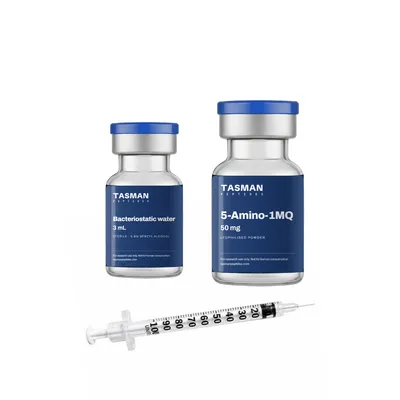
The 5-Amino-1MQ starter kit contains one 50 mg vial, 3 mL of bacteriostatic water, ten 0.5 mL insulin syringes and 20 alcohol swabs. It groups the reconstitution supplies for bench work in one order. The vial is the same product sold on its own.